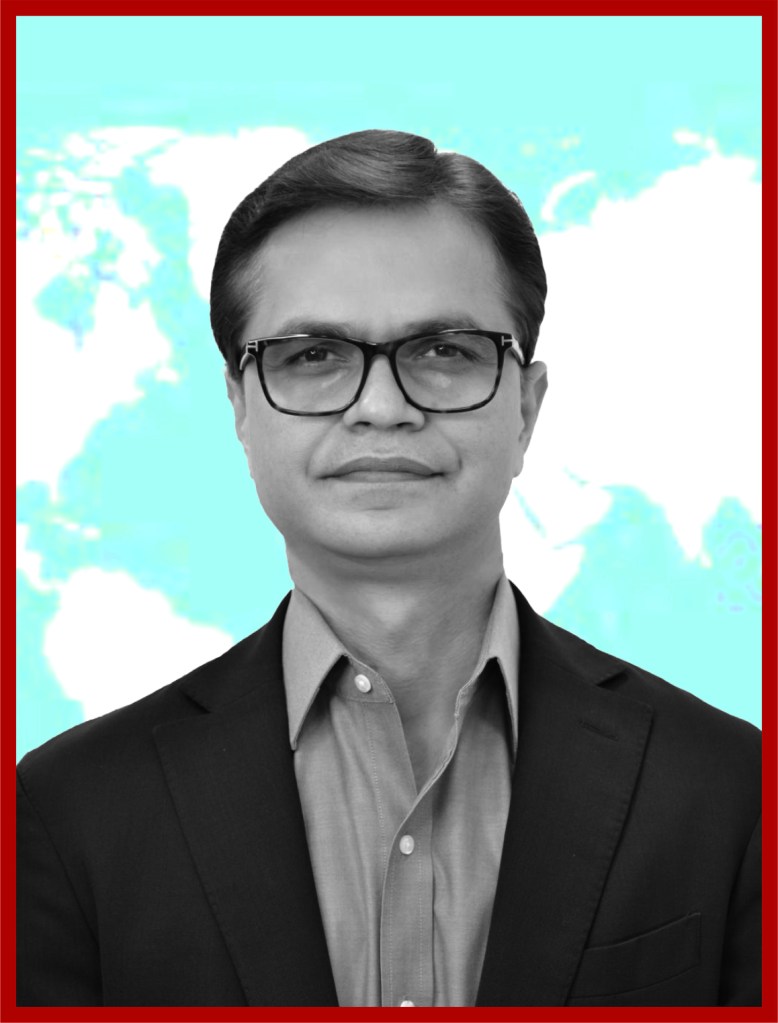
Prof. (Dr.) NishaKant Ojha is a distinguished Ph.D. and Post-Doctorate alumnus from Aalborg University, Denmark. He is a globally acclaimed expert in artificial intelligence, IoT, machine learning, and next-generation technologies. In India, he holds a prestigious position as an Eminent Faculty member in Cyber, Aerospace Security, and Counterterrorism, collaborating closely with the Defense Tri-Services and Para Military Forces. In this interview Dr. Ojha talks about Taiwan’s semiconductor industry and its role in its national security. He also explains the importance of semiconductors for India-Taiwan relationship and how Taiwan’s semiconductor industry will shape its geopolitical aspirations.
“The Next War Will Be Silent: It won’t start with tanks or troops—but with chip shortages, cyber intrusions, and tech embargoes. Taiwan is on the frontlines of this new warfare—and its role is only growing.”
Prof. (Dr.) NishaKant Ojha
Indo-Pacific Politics (IIP): How did semiconductors contribute to Taiwan becoming a global geopolitical player?
Prof. (Dr.) NishaKant Ojha: Taiwan’s “Strategic Industrial Policy” contributed to it. In the 1980s, Taiwan identified semiconductors as critical to its national development. Government think tanks like Industrial Technology Research Institute (ITRI) and the Electronics Research and Service Organization (ERSO) were mobilized to transfer tech from abroad and incubate domestic players. The formation of TSMC in 1987, with tech from Philips and capital from the government, marked a pivotal moment.
First Pure-Play Foundry Model: Unlike vertically integrated firms, TSMC’s model focused exclusively on manufacturing chips for clients—ushering in a new era of IP and design separation. This transformed global semiconductor economics, enabling companies like Apple, Nvidia, and AMD to rely on Taiwan for production.
Technology Leapfrogging: Taiwan invested over 3.5% of GDP into R&D by 2023, ensuring it stayed ahead in EUV lithography, FinFET architecture, and now GAA-FET technologies. It currently leads at the 3nm process node, with plans to introduce 2nm chips in 2025.
Resulting in Strategic Centrality: Taiwan’s strategic bet converted it into the world’s indispensable semiconductor hub, now sitting at the centre of economic warfare, cyber operations, and great power rivalry.
IIP: What is Taiwan’s real weight in the global semiconductor supply chain?
Prof. (Dr.) NishaKant Ojha: Production Dominance: Taiwan accounts for 63 percent of global foundry revenue, with TSMC alone commanding over 90 percent of production below the 7nm threshold. These nodes are critical for AI accelerators, military-grade processors, and high-performance computing (HPC).
Key to Advanced Technologies: Taiwan supplies:
• ~80 percent of Apple’s A-series chips
• 100 percent of Nvidia’s A100/H100 chips
• Chips used in DoD contracts via subcontractors
• Global Economic Impact: Any disruption to Taiwan’s semiconductor output could paralyze over 40 percent of global electronics and potentially result in a $1.6 trillion economic shock, according to a BCG-SIA joint study (2023).
• Core Node in Chip Diplomacy: Taiwan is indispensable to US, Japanese, and European tech ambitions and is part of strategic tech partnerships such as Chip 4 Alliance (U.S., Japan, Korea, Taiwan).
“Taiwan is indispensable to US, Japanese, and European tech ambitions and is part of strategic tech partnerships such as Chip 4 Alliance (U.S., Japan, Korea, Taiwan).”
Prof. (Dr.) NishaKant Ojha
IIP: How does Taiwan’s semiconductor ecosystem compete with Chinese chip technology and AI infrastructure?
Prof. (Dr.) NishaKant Ojha: There’s a gap in fabrication nodes between what Taiwan produces and what China produces:
- TSMC: Mass-producing at 3nm, preparing for 2nm with backside power delivery
- SMIC (China): Limited to 7nm DUV, unable to acquire ASML’s EUV tools due to U.S.-led export restrictions
- AI and Quantum Hardware Control: Taiwan is the manufacturing backbone for AI chips (e.g., Nvidia’s H100, AMD’s MI300X). These are essential for running LLMs like GPT-4, Gemini, and Baidu’s Ernie.
- China’s Catch-Up via Poaching & IP Transfer: Reports (Nikkei, 2024) confirm over 3,000 Taiwanese engineers have been hired by Chinese entities in the past five years. Taiwan has passed National Security Laws (2021) to criminalize unauthorized IP export.
- Beijing’s $150B+ IC Investment vs. U.S.-Taiwan Joint R&D: Despite heavy state funding, China lags in (Electronic Design Automation)EDA tools, lithography, and advanced materials. Taiwan’s partnership with the U.S. ensures it remains technologically superior.
IIP: Is Taiwan’s chip industry being actively targeted by China?
Prof. (Dr.) NishaKant Ojha: China’s cyber offensive campaigns have actively and regularly targeted Taiwan’s chip industry. PLA-affiliated groups (APT 41, Mustang Panda) have attacked TSMC, MediaTek, and ASE Technology.These campaigns target process blueprints, EDA tools, and chip defect logs—vital for reverse engineering.
• Talent Espionage & Shell Firms: China uses intermediaries in Malaysia, Singapore, and Hong Kong to recruit Taiwanese professionals, offering packages exceeding NT$10 million annually.
•Military Options as Leverage: Taiwan’s fabs are concentrated in the western corridor. A kinetic conflict could disrupt 90 percent of global advanced chip supply. U.S. has quietly developed “chip evacuation plans” and “clean room airlift protocols” in case of PLA blockade.
IIP: How does Taiwan’s semiconductor sector feed into its national security framework?
Prof. (Dr.) NishaKant Ojha: Taiwan’s technological deterrence is worth mentioning here. The “Silicon Shield” isn’t just symbolic—Taiwan’s chip output ensures mutual vulnerability. Destroying Taiwan’s fabs would backfire on China, destabilizing its own digital economy.
Taiwan’s semiconductors have dual-use capability. It’s industry produces chips that power: Satellites, encrypted comms, signal processing units, advanced radars and next-gen UAV AI processors, ASICs and FPGAs for classified defense missions
Global Security Integration: Taiwan is part of a tech-intelligence complex, quietly supporting U.S., EU, and Japanese defense contractors with chips that are otherwise embargoed in China.
“Taiwan is part of a tech-intelligence complex, quietly supporting U.S., EU, and Japanese defense contractors with chips that are otherwise embargoed in China.”
Prof. (Dr.) NishaKant Ojha
IIP: What would it take to unlock full-scale semiconductor cooperation between India and Taiwan? What are the roadblocks?
Prof. (Dr.) NishaKant Ojha: For India-Taiwan semiconductor cooperation, we need:
• Bilateral Tech Security Pact: Formal agreements that ensure IPR protection, non-disclosure laws, and dual-use controls to build trust.
•Special Economic Zones: India should create exclusive Taiwan-led SEZs with pre-built infra, power redundancy, and clean room readiness.
•Academic Pipeline: Institutes in India (e.g., IITs) must tie up with Taiwanese universities to train 100,000+ semiconductor engineers over 10 years.
Current Hurdles:
• Strategic Pressure from Beijing: China views India–Taiwan ties as a red line. Cyber pressure, trade friction, and diplomatic coercion are active deterrents.
• Execution Delays in India: Cases like Vedanta-Foxconn project fallout (2023) have shaken confidence in India’s readiness.
• Lack of Regulatory Clarity: Taiwan seeks better clarity on foreign direct investment norms, customs clearance for sensitive chip-making equipment, and long-term tax incentives.
IIP: How will Taiwan’s semiconductor sector shape Indo-Pacific geopolitics over the next decade?
Prof. (Dr.) NishaKant Ojha: Chokepoint Technology Power: Control over sub-5nm fabrication gives Taiwan invisible leverage in shaping security architectures across the Indo-Pacific.
Tech-Military Convergence: Taiwan’s chips power AI for missile targeting, maritime surveillance, and ISR systems in countries like the U.S., Japan, and Australia.
Indo-Pacific QUAD+ partners will increasingly rely on Taiwanese fabrication for secure chipsets.
Deterrence Against Tech Authoritarianism: Taiwan will play a central role in resisting China’s digital hegemony by supplying democratic nations with the tools to build trusted computing platforms.
Supply Chain Diversification with India & ASEAN: Taiwan is expected to set up ancillary and backend chip units in India, Vietnam, and the Philippines to build resilience against maritime disruptions.
IIP: Do you have any concluding thoughts for our readers?
Prof. (Dr.) NishaKant Ojha: Semiconductors are the Digital Arsenal: Control over chip manufacturing equals control over data, AI, space systems, and economic sovereignty. Taiwan isn’t just making chips—it’s securing the global digital future.
India-Taiwan Tech Axis Is Inevitable: If India wants to reduce its $60+ billion electronics import bill, dominate AI, and protect its national cyber infrastructure, partnership with Taiwan is non-negotiable.
The Next War Will Be Silent: It won’t start with tanks or troops—but with chip shortages, cyber intrusions, and tech embargoes. Taiwan is on the frontlines of this new warfare—and its role is only growing.
 क्षेत्रीय संवाद (Platform for Regional Discourse ) 區域對話的平台