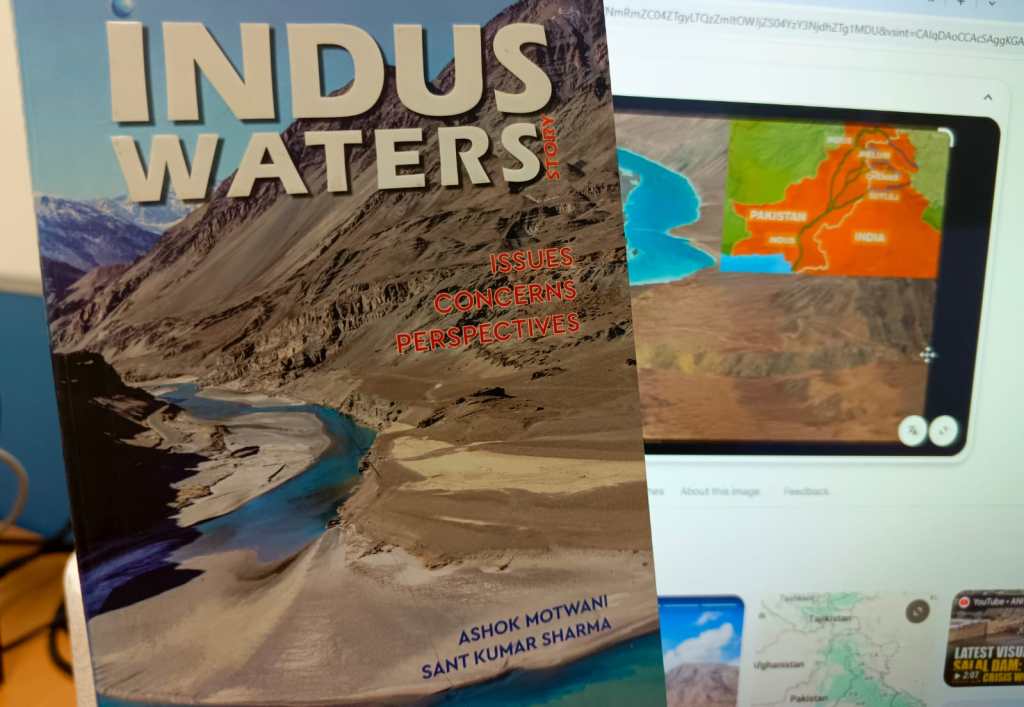
details: ‘Indus Waters Story, Issues, Concerns, Perspectives’ by Ashok Motwani and Sant Kumar Sharma
Preface: Why Discuss Indus Waters Now?
On 14 February 2019, a suicide attack was conducted by a Jaish-e-Mohammed (JeM) identified as Adil Dar by intelligence agencies) on a convoy carrying the Central Reserve Police Force (CRPF) personnel in Pulwama, which killed at least 40 men. This incident triggered public outrage against Pakistan across India, with people urging the Central government to take punitive measures against the perpetrators and those providing them sanctuaries, using all options at our disposal, including cessation of the flow of Indus waters.
Over a couple of years earlier, the September 2016 Uri attack by four terrorists was also an occasion when similar demands for blocking the flow of Indus waters were made. The Uri attack led to ‘Surgical Strikes’ as a retaliatory measure aimed at some terrorist camps inside Pakistan Occupied Jammu Kashmir (POJK). However, stoppage of waters flowing into Pakistan was not an option exercised; perhaps, it is impossible to do it as fast as military kinetic action such as Surgical Strikes that could be used as a deterrent action.
Rhetorically, demands for stoppage of waters may seem attractive and had (they still have) a lot of political traction too. As a knee-jerk reaction, the proposal served to showcase the pent-up public anger and frustration. Beyond that, this did not have much meaning in the short term as waters continue to flow into Pakistan rivers, as before. Despite repeated calls to stop these flows, it is impossible at a short notice since adequate barrages or storage dams to divert or discontinue these flows altogether just do not exist.
As a result of such demand raised after the Uri attack, the Central Government had set an Inter-Ministerial Group (IMG) to examine the issue seriously. Incidentally, the Indus Waters Treaty (IWT) provides the necessary legal framework that governs the flows in international rivers that traverse the two countries. Once again, after the Pulwama attack, there was a popular demand for the stoppage of waters and sporadic demands for scrapping the IWT unilaterally and immediately. For those demanding the scrapping of the Treaty, it means that this could have been an effective way of punishing Pakistan, and must be exercised, without any hesitation. But the consequences of such unilateral punitive action were not fully understood by those making such demands. Whether the provisions of the Treaty and international riparian laws would allow doing so is a moot question.
It is, therefore, imperative to understand the issue related to IWT for a wider public debate. In this spirit, this book is a modest attempt to complement the existing literature on IWT available in the public domain. Ironically, it seems that though the issue is of vital significance vis-à-vis India-Pakistan relations in the context of upper riparian and lower riparian, there is a dearth of enough literature on the topic which is readily available. This issue had to be dealt with in professional life for the first time during a stint with Star News (Hindi) in 2005 after Pakistan objected to the Baglihar Hydropower project on the Chenab river.
Getting a copy of the complete text of the IWT, reading and trying to make sense of this highly technical document, which was framed after eight years of negotiations, is not an easy task. The office of the Indus Commissioner of India located at CGO Complex in Delhi came to the rescue and the requisite text was supplied by them. Beyond that, understajnding the text in little snatches, every now and then, led to interactions with several engineers. Not that it helped much even then!
On 27 August 2012, six Hizbul Mujahideen (HM) terrorists attacked a project site at Adipora village in Bandipora district. The location housed dozens of workers and heavy machinery engaged in dredging Wullar lake, the vast natural sponge that Kashmir is endowed with.
Indus Water by Ashok Motwani & Sant Kumar Sharma
On 27 August 2012, six Hizbul Mujahideen (HM) terrorists attacked a project site at Adipora village in Bandipora district. The location housed dozens of workers and heavy machinery engaged in dredging Wullar lake, the vast natural sponge that Kashmir is endowed with. The Rs 400-crore project lost steam thereafter and was virtually abandoned as the workers were threated to flee or face the consequences (usually a euphemism for a threat to be shot dead by terrorists). The attack by HM harmed the residents of Kashmir the most two years later, in September 2014 floods. The fury of the floods could have been much milder had the flood protection and allied works not been harmed by the HM attack.
The incident was reported and treated by various newspapers based in the Kashmir valley, and outside, as a fairly commonplace terrorism-related event, something that happens in the Kashmir valley with monotonous regularity. Of course, it was mentioned that the attack has been carried out by the Mujahideen at the behest of Pakistan as it was violative of the IWT provisions. This meant that the Mujahideen were acting to guard Pakistan’s interests as they interpret it. It also means that Pakistan is not beyond using terror proxies as a tool to enforce any provision ort provisions of the IWT on which the two nations differ.
The larger implications of the terrorist attack on what is usually termed Tulbul Navigation Project (in India) or the Wullar Barrage (in Pakistan) were not adequately discussed or debated by the media or civil society and the academia in Kashmir, leave aside India. At least not at that time, and one hardly has come across any well written article that explains it in some detail. It was underplayed by those who cover Kashmir routinely, whether deliberately due to fear of the HM or because of not comprehending it fully, is difficult to say.
Drabu (2019) argues that ‘Other than being held responsible for causing further bitterness in relations between the two nations, India will not gain anything for now by abrogating the Indus water treaty’. regarding the treaty, he further states that the treaty has withstood the acrimonious relationship between the two neighbours, including the three wards. it is not surprising then that it is considered as one of the most successful water-sharing arrangements in the world today.’
He further asserts that:
There is a good potential for constructing a number of smaller storages, possibly in cascade, on the tributaries of Jhelum and the same are permitted under the treaty—the volume of these storages would though be small. it is worth mentioning here that till date, no storage of any type has been constructed by India on these rivers. just to highlight here, if the storage volume permitted by the Treaty for Jhelum basin has been available, it could have easily moderated the level of flooding Kashmir experienced in September 2014. The relevant figures of storage allowed under the IWT provisions have not been given in the article. of course, they are mentioned in the original document.
While examining the demand/s made for stopping the flow of water to Pakistan, he asks, ‘is this something that is practical and achievable?’ according to Drabu:
since India is anyway using nearly all the flows of the eastern rivers, any blockage of the flow of waters would essentially mean blocking the flow of the three western rivers which incidentally contribute more than 80% (117 billion cubic metres—BCM) of the flow of the Indus basin. the stoppage of the flow of water to Pakistan can be achieved either by storing this water and/or diverting the flow of these rivers.
For him, it is very clear that if India today were to abrogate the treaty, for now, nothing would change on the ground. In terms of water availability for Pakistan, it would continue to receive the flows till India plans and completes its storage and/or water diversion projects.
With the Indus basin supporting 90% of Pakistan’s agriculture and employing more than 40 % of the population, the common man in Pakistan will see it as India’s attempt to strangulate and starve his people and the country. It would arouse fear and create uncertainty in his mind. Without Pakistan actually feeling any impact of the abrogation of the Treaty, such an action would only provide fodder to lobbies in Pakistan who are keen to see [the] deterioration of relations between the two countries. It would suit their agenda and would be a God-sent opportunity to exacerbate the tensions between the two countries.
Let us assume that no changes are possible in the Treaty in the short term immediately. Yet, within the scope of the Treaty, a lot can be done by India to exercise its rights to the fullest and that is what we will examine over the next few chapters. The first thing needed for that is an understanding of the nuance es of the Treaty, political will to go ahead with exercising India’s rights to the fullest and asking engineers to design projects aimed at doing so.
Incidentally, the IWT divides the Indus River basin between India and Pakistan, and on paper, the two nations have been allotted three rivers each. The three rivers, for the sake of convenience and based on their geographical location, are called the Eastern rivers and the Western rivers. The three Eastern Rivers are (Sutlej, Beas and Ravi) allotted to India. On the other hand, Chenab, Jhelum, and the Indus are called the Western Rivers and have been allotted to Pakistan.
In terms of the total volume of waters available in the Indus basin, 80.52 per cent has been given to Pakistan, and only 19.48 percent is India’s share under the Treaty. Of even this smaller share, India has not fully utilized its share yet altogether it is alleged that this Treaty is inequitable and unfair to it. Interestingly, similar allegations of the Treaty being unfair to them are being levelled by Pakistan frequently. They keep on saying that India has violated this or that provision of the Treaty at one place or the other in Jammu and Kashmir (J&K), on one of the Western Rivers. These allegations of wrong-doing and Treaty violations from Pakistan mostly concern the Chenab on which the Marala headworks are located.
It appears, a desire to be in total control of all the Western Rivers that propels Pakistan’s thinking vis-à-vis India. If nothing else works, (theoretically) forcefully annexing the whole of J&K will give it the entire territory in which Chenab, Jhelum and the Indus flows. For this to happen, the cheapest option available to Pakistan is to foment trouble in the State and build a narrative that the ‘People want to be a part of Pakistan’. In this context, the following chapters will deal with various issues related to the riparian rights of both the nations. Different provisions of the Treaty and related issues will also be discussed in detail.
Bloomsbury Publication
https://www.bloomsbury.com/in/indus-waters-story-9789389611847/
 क्षेत्रीय संवाद (Platform for Regional Discourse ) 區域對話的平台