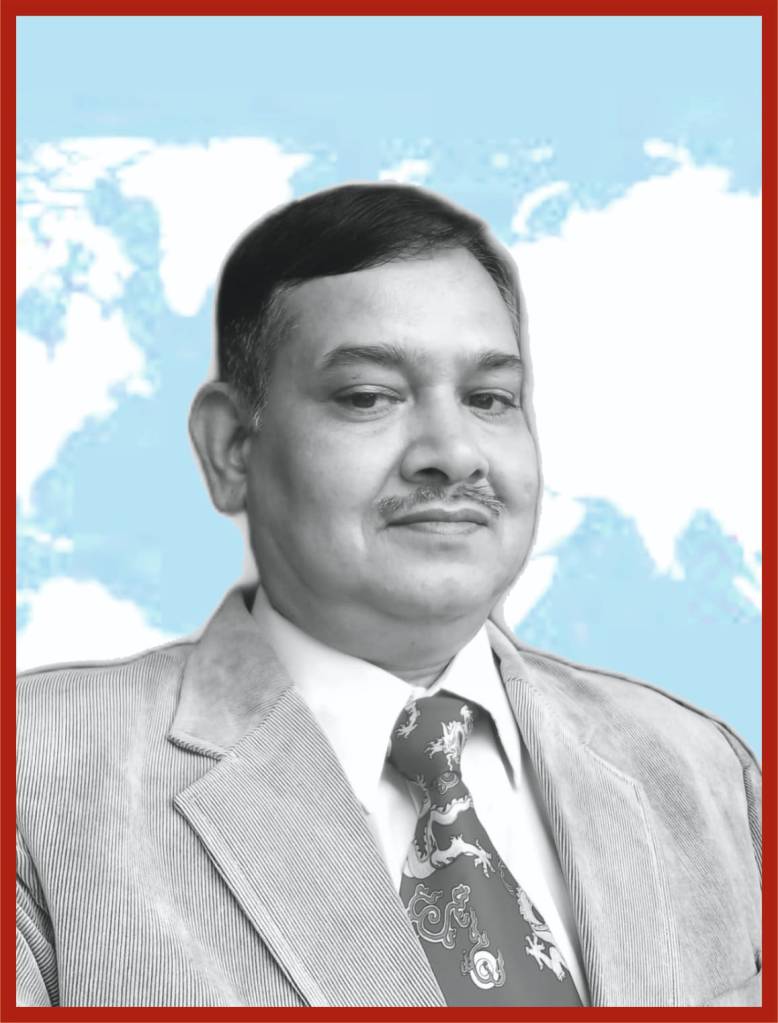
Capt. Kamlesh Kumar Agnihotri (Rtd.) is an Indian navy veteran placed at New Delhi’s National Maritime Foundation (NMF) as a Senior Fellow. He earlier served as a Senior Fellow at the Centre for Joint Warfare Studies (CENJOWS), New Delhi. His expertise for 17 years has been on Chinese Defense Forces, particularly the Chinese Navy. He currently focuses on the broader Chinese maritime and high technology issues, India-China relations, Indian Ocean security matters and the complex dynamics in the broader Indo-Pacific Region.
Capt. Agnihotri has published/co-edited nine-books and was also a short-term visiting fellow at the Department of Diplomacy, National Chengchi University from April to July 2014 where his topic of research was “Contemporary Taiwan Strait Situation and Global Security Order: India’s role in maintaining ‘Balance of Power.”
The Indo-Pacific Politics (IPP) interviewed him for the “Taiwan Interview Series” on April 29, 2025 about Taiwan and the Naval Geo-politics of the Indo-Pacific Region.
IPP: What’s Taiwan’s importance in the marine geopolitics of Indo-Pacific today?
Capt. (Rtd.) Kamlesh Kumar Agnihotri: Taiwan is very strategically located in the Pacific Ocean, particularly in the Western Pacific Ocean. It lies quite close to China, and it is also a part of the first island chain, in a way. So from Taiwan, a lot of activities of China, whether military, commercial, space based–all these activities can be quite easily monitored.
The second advantage that Taiwan has is the unique understanding of various languages, particularly the Chinese, Japanese, English language, and also the culture and the cultural connect that comes with the knowledge of these languages. Now this unique understanding of the Chinese language–though there are some minor nuances in written with regard to the traditional language, as well as the Mandarin–allows them to monitor the various Chinese sites, writings and everything, and get the Chinese mindset on various issues, whether they are of political nature or military nature or commercial nature, or even pro-Taiwan viewpoints, or even anti-Taiwan stances that they have been putting out.
The knowledge of Japanese similarly allows them to connect very well with Japan and of late, Japan and Taiwan have been forging very good alliance, particularly in light of their mutual animosity vis-a-vis China. And Japan has gone on record to say that Taiwan’s problem with China is also going to be the Japanese problem. So the language of Japan, which is known to most of the Taiwanese, helps them to connect on a cultural as well as on a geopolitical level, with the Japanese. It is very clear they are very friendly with the United States, English is the lingua franca for so many other countries, including with India. So they are able to cover a wide swath of the world by knowledge of these, Chinese, Japanese and English languages and the cultural insights that comes along with it.
The third advantage that Taiwan has is the special relationship with the US, which enables access to advanced information, communication technologies and even the nuclear electricity and the general support involving the activities and actions to make itself more defendable vis-a-vis China. Though a lot of these activities are not in the public domain, but it is common understanding that the US is helping out Taiwan and advising it on how to erect its defense infrastructure so that as and when some untoward incident with regard to reunification takes place, the Taiwanese can stand up for themselves.
And the fourth and the most important, is their own technological prowess. We all know how advanced they are on the semiconductor front, and they are making chips which are very-very small in size. Their technology is so advanced that even the US has double thoughts about whether to impose the tariff and non-tariff barriers on Taiwan. Taiwan is collaborating on technology front with the US and various other countries, and this is one reason why even China is looking at reunification with a softer approach, so that it is able to get the technological know-how and infrastructure in relatively intact condition, particularly with regard to the semiconductors, and control it without having to resort to hard measures.
So these are the advantages that Taiwan inherently has, and they are all going to affect the geopolitics in the Indo-Pacific today. And because of these advantages, various countries are looking to Taiwan as a major entity which can stand up to China and resist its revisionist agenda.
‘And because of these advantages, various countries are looking to Taiwan as a major entity which can stand up to China and and its revisionist agenda.’
Capt. (Rtd.) Kamlesh Kumar Agnihotri
IPP: What are the other naval powers in the Indo-Pacific, and what is Taiwan’s geo-strategic relationship with each of them?
Capt. (Rtd.) Kamlesh Kumar Agnihotri: The other naval powers in the Indo-Pacific are, of course, the United States with its powerful, deployed military presence; Japan, because of its location; South Korea and various ASEAN countries, particularly to the south of Taiwan. The nearest country is Philippines.
So now coming to each one of them. The US, as I said earlier, shares a special relationship with Taiwan wherein all the military defense equipment, some platforms, also the aviation platforms, F-16, etc, have been coming from the US. US has also been helping them out with regard to the maritime domain awareness, both the space based and also terrestrial based. The US is also helping out with their power generation and distribution. The US, military and political advisors are going to and fro quite often, and it is only because of the US support [to Taiwan] that may be China has not pushed its reunification agenda to the extent that it would want to do. So there is a lot going on with regard to the US permanent military presence, and in a way this itself, is acting as a great deterrence.
While being on that subject, I would like to draw your attention to the fact that the United States Navy often conducts its freedom of navigation operations, which involves US Navy ships sailing to the Taiwan Strait, and also sailing around various disputed islands like the Paracel islands [Xisha Islands] as well as the Spratly Islands [both in South China Sea]. So these put out a huge message to China with regard to what US is capable of and what it intends to do in that area. All this goes to help Taiwan, also in reassessing its security paradigm.
Japan, for some time now, particularly since 2012 has been particularly very collaborative with Taiwan in geopolitical matters, in fact, in various dialogues that Taiwan holds. The Japanese foreign minister has clearly gone on to say that Taiwan’s problems with China are also going to be Japan’s problems. People do tend to ask as to what extent Japan will intervene or interfere if something happens between China and Taiwan. To that, the answer is, of course, they are quite guarded, but not so guarded as to say that we will certainly do everything to support Taiwan from the back end. And the intensity of Japan, Taiwan collaboration in various aspects, particularly political as well as I would say military issues is on the rise somewhat.
South Korea never used to take a stand vis-a-vis anything related to outside the maritime zones of South Korea. But now it has started taking a stand, particularly with regard to Taiwan and the South China Sea, to say that what China is doing in certain cases is not acceptable. So that’s a welcome development, and it should invariably help Taiwan project its anti-China agenda, along with the South Korea. But South Korea, as of now, is a minor geopolitical player.
With regard to ASEAN countries, I would like to only flag two countries here, particularly Philippines, in a big way, because Philippines is a treaty partner of the US, and Taiwan has got equal amount of support of the US so all the outlying islands of Philippines, north of Philippines, where US is doing major exercises now with the Philippines maritime forces, is helping out in sanitizing the various straits between Taiwan and the South China Sea, particularly the Bashi channel. [The Bashi Channel is a waterway between Mavulis Island of the Batanes Island, Phillipines and Orchid Island of Taiwan.] The combined military presence of the US, Philippines and Taiwan, in some way, is generally sending a great strategic message to China.
Other country I wanted to flag is Vietnam. But Vietnam has got its own compulsions, and again, it is a minor player with regard to what it does with Taiwan. But all said and done, every voice which opposes China’s reunification agenda, and which can stand up on its own is in a way, favoring the stand of Taiwan.
‘The Japanese foreign minister has clearly gone on to say that Taiwan’s problems with China are also going to be Japan’s problems.’
Capt. (Rtd.) Kamlesh Kumar Agnihotri
IPP: What is China doing currently to follow up on its long held reunification agenda, particularly since the new DPP administration took over?
Capt. (Rtd.) Kamlesh Kumar Agnihotri: China released a white paper on Taiwan in August, 2022 the title of the white paper itself was “The Taiwan Question and China’s Reunification in the New Era.” It implied a historically transformed and rejuvenated China of the new era. And I’m quoting these verbatim from the white paper. These phrases consider the current time period as a new starting point for reunification. China also wants that we, when it says we, means China, will always be ready to respond with the use of force or other necessary means to interference by external forces. So when it says external forces, without naming the US, it has already made its stand clear by the release of this boldly stated white paper. It generally coincided with the visit of Nancy Pelosi in August 2022 and has since been followed through with appropriate military posturing and heightened patrolling by maritime law enforcement agencies, duly backed by a multi pronged media, legal and psychological onslaught; What we all say, as part of the three warfare strategy.
Now this proactive trend assumed particularly alarming proportions during the 10-month period in 2024 that is the time I was there in Taiwan, particularly in January elections in Taiwan, running through the presidential inauguration in May, culminating with President Lai Ching-te’s first speech on 10th October to mark Taiwan’s National Day. Now why these dates are important?
So what happens is that these occasions, like the Presidential inauguration and the President’s first speech on the Taiwan National Day, have been used by the Chinese to showcase their aggressive behavior around Taiwan. Why did they conduct exercises within three days of Taiwan’s new president assuming office on 20th May? That is the time– I was there– the Chinese PLA conducted a well publicized exercise called ‘Joint Sword-2024A,’ at an unprecedented scale all around Taiwan. It lasted only 24 hours, but it was a multi-domain exercise involving PLA Navy ships, submarines, PLA Air Force aircraft, amphibious troops, rocket forces and coast guard ships. For the first time it involved the coast guard ships. The exercises were also spread over many additional areas around Taiwan, including the outlying islands of Kinmen Matsu and Wuqiu.
And after Presidential speech on the Taiwan National Day on 10th October, China immediately mounted another ‘Joint Sword Exercise.’ It was called ‘Joint Sword-2024B multi-service exercise’ on 14th October. This time, the locations of exercise were even closer to Taiwan,–all around Taiwan with greater intensity and larger force, including participation of the Liaoning (遼寧) aircraft carrier group. So first time the aircraft carrier group was also brought in, and that’s a huge escalatory message that China wanted to give to Taiwan in particular and to the world in general. This escalatory trend in PLA’s overtly aggressive maneuvers vis-a-vis with Taiwan clearly indicates that–it is not letting up in these activities.
So it was again evident in exercise this year, “Strait Thunder-2025A,” conducted on the first and second of April 2025. It involved a lot of ships and PLA airforce aircraft came all over the place. The objective was very clear, seizing control of key areas and controlling choke points. Chinese always like to be a bit obfuscating, so they have not given specifics, but “seizing control of key areas and controlling choke points” itself points to some kind of a blockade that they wanted to practice. So there is a lot happening.
IIP: What are the possible strategies and action plans that Taiwan could adopt to counter the challenge of reunification agenda of China?
Capt. (Rtd.) Kamlesh Kumar Agnihotri: Taiwan has obviously been working on two fronts, that is, improving its indigenous capacity to oppose the Chinese agenda and also augment capabilities to the extent that it can at least delay, if not totally avoid, the reunification agenda by force, if it comes to that. Towards that, it is improving its anti-amphibious capabilities, and the US is advising them in a great way. There is a complete declassified document called the Operation Causeway, which was supposed to be an American plan to conduct an amphibious raid on Taiwan to get rid of the Japanese at that moment in the Second World War. That plan has been brought out now as declassified, and Taiwanese are being asked to go through the plans in detail, particularly with regard to the intelligence as to what the Japanese were up to, to prevent the American amphibious forces from landing.
At this point, we can surmise that the operation never took place probably because the American intelligence at that moment thought that the Japanese defensive measures were quite foolproof and it would have a great adverse impact on the American campaign. They got this impression that the Japanese had taken foolproof defensive measures to thwart amphibious capabilities of the US. Now the same amphibious tactics are being told to the Taiwanese, to ensure that the Chinese do not have an easy passage across the beaches of Taiwan, and are not able to land easily.
Taiwan is said to follow something like a porcupine strategy, wherein when threat occurs, the porcupine makes itself into a ball and rolls up and locks down with its thorns pointing outwards. So even the offshore wind turbines and those installations, the various barbed wires, the whole lot of underwater and above water obstacles are all part of the strategy that is going on. Of course, a lot of it is still in the classified realm, but we, being domain people, know that these things can happen, or they are happening. They are also getting weapons from the United States. The United States is helping them in the maritime domain awareness effort that is called ‘Common Operating Picture,’ the space cooperation is happening with the United States. And so the United States is their major defensive partner and political advisor.
Taiwan is also looking to have space-based and maritime domain awareness cooperation with other countries, and they are looking for private players to launch various low Earth orbit communication satellites. This is the real collaboration that India can do, because India is able to make satellites, India is able to launch satellites. India can prepare various kinds of payloads. And so this is one part that the Indian civilian space industry has been pitching for, that if you want to do something with regard to space, then space cooperation is one huge area of activity which can be looked into within the confines of the current diplomatic limitations in place. To facilitate this very kind of cooperation, India has made a commercial company, called NSIL (New Space India Limited), so NSIL can cooperate with Taiwan’s space bodies and it can very well happen.
Taiwan has got a new Southbound Policy, wherein it is looking for cooperation, at least the moral support, of a whole lot of countries from the ASEAN group, as well as South Asia. I say South Asia because it has India. Of course, there are certain other countries, also, particularly Pakistan, but then that’s up to Taiwan to decide what kind of relations it wishes to maintain with Pakistan. So these are the various action plans that Taiwan is visibly taking and which are known to us.
‘India has made a commercial company, called NSIL (New Space India Limited), so NSIL can cooperate with their [Taiwanese] space bodies and it can happen.’
Capt. (Rtd.) Kamlesh Kumar Agnihotri
IIP: What are India’s stakes in the Indo-Pacific, vis-a-vis Taiwan? How is India impacted by China’s aggression in the Taiwan Strait?
Capt. (Rtd.) Kamlesh Kumar Agnihotri: Though India does not have a direct connect with the region, per se, a large amount of India’s sea borne trade, in fact, to the tune of more than 55% by volume transits through the Western Pacific Sea lanes. Therefore, a large portion of India’s secondary areas of maritime interest–and India has promulgated its primary areas of maritime interest and secondary interest in two documents–India’s maritime Doctrine of 2009 as well as India’s maritime security strategy of 2015 wherein a large portion of primary area of interest, of course is the Indian Ocean. We are not talking about that in this interview; However, a large portion of India’s secondary area of maritime interest lies in the Western Pacific region, and one of the main reasons for that is trade. So it makes it imperative for India to carefully weigh its options and response plans with a view to safeguard its national interest. And here national interest is the economic interest itself.
The Western Pacific region also qualifies as India’s secondary area of interest on yet another parameter. This parameter is laid down in India’s maritime security strategy, which is based on considerations of India’s diaspora, overseas investments and political relations. Since these factors form an intrinsic part of India’s national interest, it is incumbent on Delhi to respond to current developments in the region in a measured manner of course. It would be unrealistic for India to intervene militarily at such an extended range. I mean, our primary area of domination, or our prime area of influence is the Indian Ocean region, so we won’t have that kind of force to send to Western Pacific extend range. But there are other levers of so-called DIME construct–the diplomatic, informational, military and economic. So if we exclude the military part, diplomatic, informational and economic leverages–must be suitably exercised, either in standalone mode or in various combinations for ensuring best possible outcomes for India. So some of the things could be like, ensuring that Taiwan continues to exist as an independent state, so that the Chinese military is focused in a big way with Taiwan itself. Of course, for achieving it in some logical manner, India will may be, needs to somewhat review its one China policy.
I wonder how that can be done, but I’m sure nuances can be found which would allow India to have better relations with Taiwan. And, secondly, to help out Taiwan whenever, (this is again my suggestion) China tries to do some ratcheting up, particularly occasion-specific activity, if they want to do something, say on Taiwan’s National Day or on the day of Taiwan’s presidential inauguration. So a little bit of heightened sense of deployment in the Indian Ocean, where we know that a lot of China’s energy and commodity trade passes through, should be entirely doable. It doesn’t have to be any overt action. It just has to be messaging by sending our ships closer to the Chinese commercial traffic or closer to the Chinese naval ships, which are always deployed in peacetime in the region. It is quite possible in peacetime. In wartime, of course, you cannot approach a warship of another country, because that will be considered differently.
As you know, the Chinese ships coming to the Gulf area for their anti-piracy patrols have to make their major passage onward, as well as return passage through the Indian areas of influence, that is in the Arabian Sea and the Bay of Bengal, and through the Andaman Sea to the Malacca Strait. So messaging can be done there. India already opposes the Belt and Road Initiative, but India can bring up these issues about the so-called China Pakistan Economic Corridor (CPEC) by naming it differently. Our issues are the territorial sensitivities through the areas in which the so-called CPEC passes. So we can always start calling it CPOKEC [China Pakistan Occupied Kashmir Economic Corridor] because China also also engages in renaming symbolisms. They like to rename various features in various areas closer to India. So we can also rename their so called CPEC corridor into CPOKEC corridor. And I think this point should find additional favor with you. Also, we must have some punitive capabilities of our own in the Indian Ocean region – not to support Taiwan in any way -, but in case China decides to heighten its posture in the Indian Ocean region, then we should have the capabilities to respond appropriately.
Last but not the least, we must leverage our membership of multilateral forums, particularly the QUAD, wherein our cooperation with the US can come in handy in trying to get maritime domain awareness over a bigger area, called the Indo-Pacific MDA [Marine Domain Awareness]. That is a part of technology transfer, because there is a critical technology working group, as also the HADR [Humanitarian Assistance and Disaster Relief] cooperation mechanism. It is a very interesting area, because ships, and even warships, can often transcend the limitations imposed by national boundaries and go beyond normal rules for conduct of HADR in emergency situations and for humanitarian considerations. Therefore, HADR situations can permit such ships to do various so-called non-traditional activities in the South China Sea, in the vicinity of East China Sea, and in the general area where Taiwan is located, except possibly in the Taiwan Strait.
Japan is also a part of the QUAD. So Japan can be asked to take more proactive measures with regard to challenging areas Chinese ships and Chinese aircraft which are flying or which are operating close to the Senkaku islands. So it will again send a clear message and also get more and more Chinese military units engaged therein. And India must see that every time more and more Chinese units and Chinese military people are engaged and assets are engaged in the Western Pacific, it is that much easier for India in the Indian Ocean region.
IIP: Is there anything else you want to add on the topic?
Capt. (Rtd.) Kamlesh Kumar Agnihotri: Yeah, I just want to close with a quotation about Taiwan, which I read somewhere during my research work. It says that ‘if knowledge is power – and knowledge is the technological knowledge and the knowledge of language and the knowledge of culture and the knowledge of how Chinese think – then if knowledge of that kind is a power–no country in the world is in a better position to influence the course of political and security affairs in the Indo-Pacific region than Taiwan.’ And if these are the strengths of Taiwan, then they should certainly be leveraged by the world at large, and India in particular, for better maritime security preparedness against a common entity of concern, that’s, of course, China.
 क्षेत्रीय संवाद (Platform for Regional Discourse ) 區域對話的平台