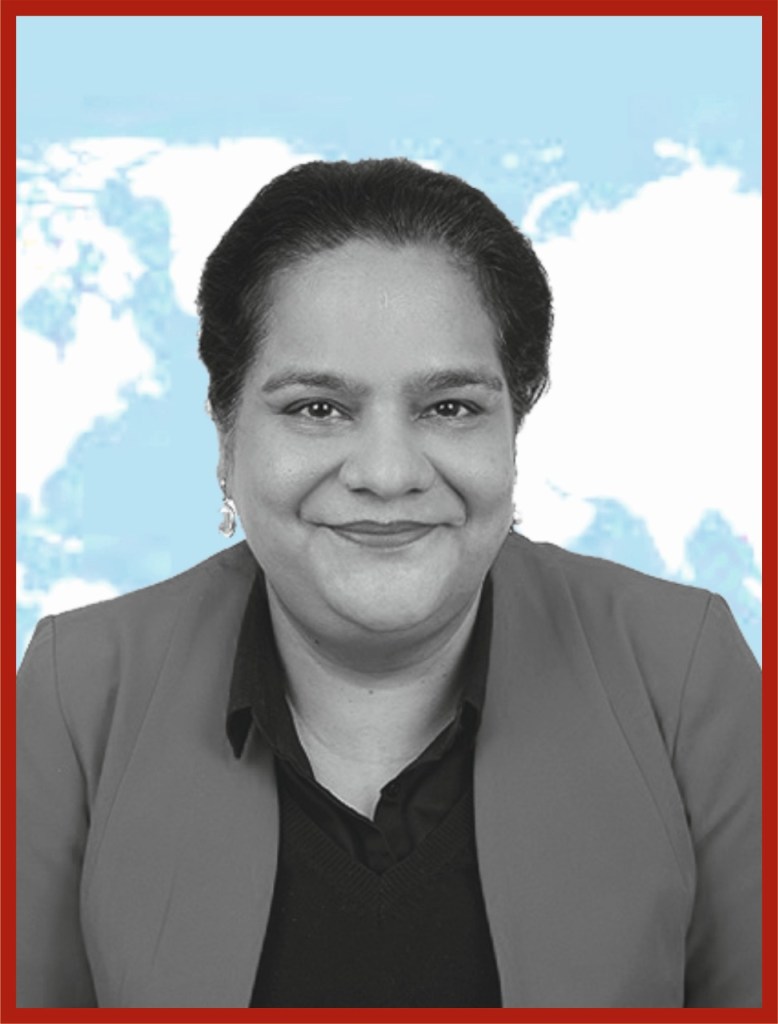
Namrata Hasija is a Research Fellow with the Centre for China Analysis and Strategy, and her primary area of interest is Chinese foreign policy and India-Taiwan relations. She was a recipient of the Taiwan Fellowship by the Ministry of Foreign Affairs (2019-20) and the Huayu Enrichment Scholarship by the Ministry of Education, Taiwan (2014-15). Before joining CCAS, she was a Senior Research officer at the Institute of Peace and Conflict Studies, New Delhi, and has been a visiting researcher at the Institute of International Relations, National Chengchi University, Taipei, and National Tsing Hua University, Hsinchu.
The Indo-Pacific Politics (IPP) interviewed her for the “Taiwan Interview Series” on May 10, 2025 about what’s stirring India-Taiwan relations in 2025 and what’s needed ahead.
IPP: What’s stirring the India-Taiwan relationship in 2025?
Namrata Hasija: It was India’s Act East Policy and Taiwan’s New Southbound Policy that initially accelerated the India-Taiwan bilateral ties. Science and technology are one of the fields in which we have numerous agreements and the base is strong.
As we approach the 30th anniversary of India-Taiwan relations, it is evident that both countries are standing at a critical juncture. The evolving geopolitical landscape, especially in the Indo-Pacific region, has brought about significant shifts in their bilateral ties, positioning them as crucial players in ensuring regional stability and prosperity. Taiwan’s New Southbound Policy, initiated in 2016, has led to a substantial expansion of cooperation with India, with a growing emphasis on the Indo-Pacific strategy. While India has articulated a clear vision for the Indo-Pacific region, Taiwan lacks an official strategy.
However, both nations share a common ground in prioritizing regional stability and security, making their partnership increasingly pivotal in the broader geopolitical context.
IIP: Education Diplomacy between India and Taiwan is certainly one important area of exchange. How is this contributing to bilateral ties?
Namrata Hasija: Undoubtedly, Indian students studying in Taiwan or the ones who are showing interest in coming to Taiwan for higher education are the traverses that have held and strengthened the bilateral relationship. However, there is scope for much progress. Taiwan, under Tsai-Ing Wen’s leadership, is leveraging its economic prospects to transform it into an ‘education hub’. Education diplomacy, thus, can become a threshold to increase Taiwan’s influence in the region, particularly India. Tapping into Indian students is a potential area because these young minds strive for better opportunities to travel abroad. As per record, after China, Indian students constitute the second-highest number of non-Americans, around 18 percent (1,93,124) in 2019-2020, studying at American institutions. Similar is the case of Indian students studying in the UK, Singapore, or South Korea. Although it is competitive, Taiwan has an opportunity to tap Indian talents by rendering awareness on its affordability, excellent lab infrastructures, cost of living, and employment opportunities. The position of 16 Taiwanese universities in QS World University Ranking (2021) and 35 Taiwanese universities in the top 300 ranks of the QS Asia ranking could be a USP to attract Indian students.
The other potential area for education diplomacy is to maintain a balance between the social sciences and the natural sciences coming to Taiwan, particularly through Ministry of Education scholarships. Mr Peters LY Chen, Director, Education Division, TECC, New Delhi also deems ‘that majority Indian students go to Taiwan for higher studies are from STEM background and programmes in the field of social sciences needs to be promoted.’ The knowledge and understanding that the social science students have about Taiwan or the bilateral relationship and the pragmatic role they can play in bridging the lack of awareness and promoting inter-cultural exchange are relatively larger as compared to a natural science student. Social science students would play a significant role in promoting this soft power, having economic and reputational benefits. Citing a parallel example, China has been extensively tapping the African continent, keeping a financial dimension in mind. However, much of the engagement has an educational dimension with African students studying in China on government scholarships. Similarly, Taiwan—to foster a long-term India-Taiwan bilateral relationship—should strategise along the same lines.
Questions on the transparency of the Confucius Institute in India, and in various other countries such as the US and Australia—with some institutes being charged with spying and misuse—avails an opportunity for Taiwan to fill the void of learning Mandarin in India. India, on the other hand, needs non-propagandist Mandarin instructors who, unlike Confucius institutes, will not control the curriculum and appointment of the faculty. This would be win-win cooperation as India faces no security threats from Taiwan, unlike China.
Taiwan should also explore tapping Indian talents to teach English under the 2030 programme of making Taiwan a bilingual state. The employment opportunity given to Indians to teach English in Taiwan would immensely help in creating awareness about Taiwan in India’s job market circle.
IIP: What kind of cultural exchange is happening between India and Taiwan? What more is needed?
Namrata Hasija: Tourism between the two countries has started and in the recent past there has been some exciting exchange of films and cinema. Tamil Film, Indian 2 featuring the legendary Kamal Hassan and directed by S. Shankar was partly shot in Taiwan in 2023. And the Taiwanese are excited about the possibility of more Indian films shooting in Taiwan as that can introduce and popularize Taiwan to Indian tourists.
Five well-known Taiwanese Films: My Missing Valentine; Love Talk; Long Time No Sea; The Silent Forest; Beyond Beauty: Taiwan from Above; were broadcasted on Indian OTT platform, MX Player from March 1 to May 31, 2022.
Taiwan’s Ministry of Culture
IIP: How do you rate the technology exchange between India and Taiwan? What’s further needed for collaboration in semiconductor, AI and other contemporary leading fields of technological innovation?
Namrata Hasija: Another area where India and Taiwan can deepen ties is in AI [Artificial Intelligence]. The Indo-Taiwan Joint Research Centre on Artificial Intelligence and Machine Learning, established in 2019 with the support from Taiwan’s Ministry of Science and Technology, facilitates academic and industry partnerships to promote research in AI and machine learning across India and Taiwan. Expanding this initiative would align with India’s Viksit Bharat plan, which aims to make India a fully developed nation by 2047, while leveraging Taiwan’s expertise in AI.
IIP: What can India and Taiwan do for mutual investments and exchange in SMEs? Any other low-profile fields with potential for exchange and collaboration?
Namrata Hasija: There are some non-science and technology areas that have good scope of collaboration between India and Taiwan–Agriculture and Tea making plus packaging.
IIP: What challenges do India and Taiwan face to the strengthening of their bilateral ties?
Namrata Hasija: One-word for this challenge is China. But there are also, many other structural issues. From the Taiwanese side, there has been significant pressure for a Free Trade Agreement (FTA), seen as an essential step for substantial investment from Taiwan. The Taiwanese argument is that most of their businesses are small or medium scale which makes it difficult for them to compete without an FTA. However, India is reluctant due to the fear that Chinese products might get a backdoor entry and also the MEA does not feel it will help in more investment coming from Taiwan. However, rather than waiting for a comprehensive FTA to be negotiated, there is an opportunity to swiftly create tailor-made, sector-specific agreements that would serve as catalysts for immediate trade.
Additionally, there is a lack of institutional stability in Taiwan-India relations. Few individuals in the Indian Foreign Service are effectively positioned to drive these ties forward. There is also minimal engagement between Taiwanese and Indian congressional and political parties. Although there are signs of progress in academic exchanges, both sides must invest more in this area.
 क्षेत्रीय संवाद (Platform for Regional Discourse ) 區域對話的平台