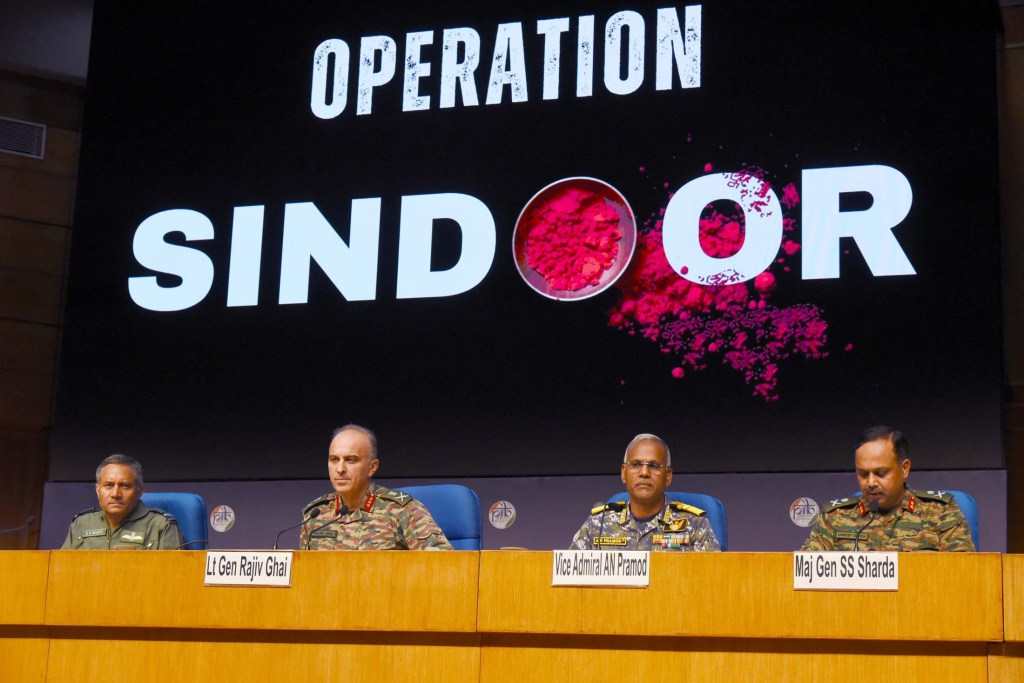
India conducted ‘Operation Sindoor’ — punitive, precision strikes on nine terrorists camps inside Pakistan after 26 men were killed by terrorists in Jammu and Kashmir’s Baisaran Valley on April 22. The victims were shot in front of their families after being specifically identified as ‘Hindus’. Three-day border skirmishes and drone strikes between India and Pakistan followed India’s missile strikes before a ceasefire was declared on May 10. Analysts have described ‘Operation Sindoor’ as a debut for New Delhi’s domestically produced arsenal and a first strategic match between the Indian and Chinese weaponry that the Pakistani military yielded during the conflict.
Prime Minister Narendra Modi said during his speech at a public event in Kanpur on May 30 that Operation Sindoor showcased India’s ”indigenous defence capabilities and the strength of Make in India to the world.” The Indo-Pacific Politics’ (IPP’s) Inside India team interviewed Prof. Madhav Nalapat, the Vice-Chair of the Manipal Advanced Research Group about the strategic significance of this contest between the Indian and Chinese weaponry.
IPP: You said Operation Sindoor between India and Pakistan was world’s first game between Indian and Chinese weapon systems. What made you say that?
Madhav Nalapat: The US is in denial mode, but since the 21st century, the Pakistan army (which in effect runs the country) is an auxiliary of the PLA [People’s Liberation Army]. Its new weapon systems have never been tested in combat before. They were [tested] in Operation Sindoor.
IPP: Did you mean a match between India’s domestically manufactured weapon system and the Chinese produced equipment?
Madhav Nalapat: Weapons entirely made in India or weapons made in India in partnership with other countries, such as Brahmos ( joint venture of Russia and India). India would like more partnerships with US companies but the US policy changes like the weather and suddenly parts run dry or other issues arise. That never happens with Russia, even during active kinetic operations with China.
IPP: Does that serve as a proof about China’s greater strategic involvement behind Pahalgam?
Madhav Nalapat: China was responsible for encouraging the Pahalgam atrocity. The CCP [Chinese Communist Party] wants to show that India is unsafe as it wants to prevent the relocation of US companies from China to India, such as Apple. Instead, nuclear armed India showed it is secure, even from the CCP weapons. Incidentally, Pakistan is being used as a test bed for CCP weapons, and we are aware of that and constantly upgrading our systems to outmatch CCP adjustments in their weapons.
IPP: Do you think the world has adequately identified it? Do you think India can claim it as a victory sales pitch to smaller countries in Global South looking for advanced weapons?
Madhav Nalapat: What the rest of the world thinks is irrelevant to success. We showed our weapons are reliable and my hope is that greater emphasis will be on ‘Make in India’ rather than ‘Buy by India’.
IPP: Can we term this as a new trend of red weapon supply china vs non-red supply chain of weapons?
Madhav Nalapat: Good characterization, but I prefer the term CCP. The colour red does not belong to the CCP.

”The US is selling weapons even though officially Taiwan is not recognized as a country, only de facto. India is on course to follow that path if Taiwan makes significant offers.”
Madhav Nalapat
IPP: Do you think Taiwan has noticed this and will this help India sell its weapons to Taiwan?
Madhav Nalapat: The US is selling weapons even though officially Taiwan is not recognized as a country, only de facto. India is on course to follow that path if Taiwan makes significant offers.
IPP: Is there anything else that you want to say on this topic?
A : Taiwan is much more important for the Free World than Ukraine, and it is time our European partners understand that in the way President Trump has.
If you have an idea or a pitch for ‘Inside India’ please email venusupad@gmail.com
 क्षेत्रीय संवाद (Platform for Regional Discourse ) 區域對話的平台