By Venus Upadhayaya
(This article was written during J.D. Vance’s trip to India from April 20-24. But because of the Pahalgam attack of April 22 and the conflict and crisis between India and Pakistan in its aftermath, it couldn’t be published in time. Meanwhile US-China reached a tariff truce for 90 days in a meeting in Geneva in May, reducing each other’s tariffs from 145 to 30 percent and 125 to 10 percent respectively. While the US-China continue to engage in a war of words during this period of truce, India and US trade deal is expected soon, according to today’s reports. We are offering this earlier unpublished article because it provides some timeless insights from a few authoritative analysts.)
Indians and Americans are working for a bilateral trade deal during the 90-day tariff pause window, the terms of which were announced on April 21. India exhibited maturity and didn’t retort to Trump’s reciprocal tariffs. Instead it has maintained what the experts termed a “strategic silence” which according to them has helped New Delhi’s cause.
The terms of reference for the trade deal came as Vice President JD Vance’s started a four-day trip to India and over a week after President Donald Trump announced a complete three-months pause on all the “reciprocal” tariffs on April 9 for countries except China.
The pause period prompted many countries, including Japan, Vietnam, and Taiwan to announce negotiations with the United States for trade and economic cooperation but India seems to be taking the lead among all—so much so that it appears like the Indian government had some foreboding of Trump’s tariff policies.
The India-US trade deal includes 19 chapters and covers issues like tariffs, goods, non-tariff barriers, and custom facilitation and investment, according to various India and global media reports. The finalization of the terms of reference to lay down a roadmap for the negotiations on reciprocal trade with India was confirmed by U.S. Trade Representative Jamieson Greer in a statement on Monday.
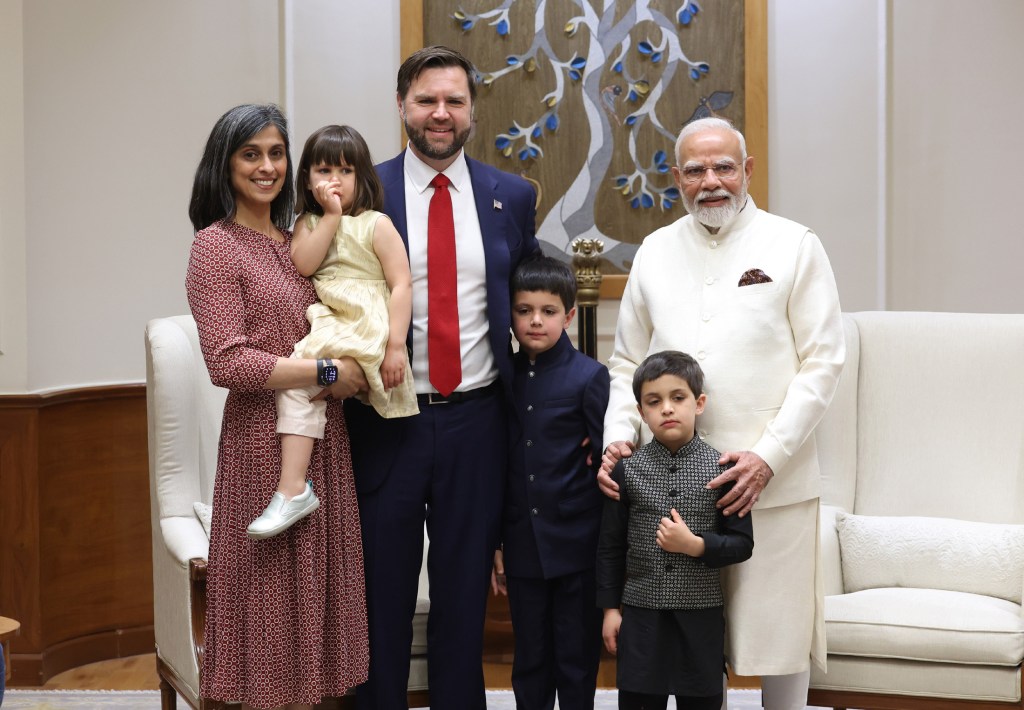
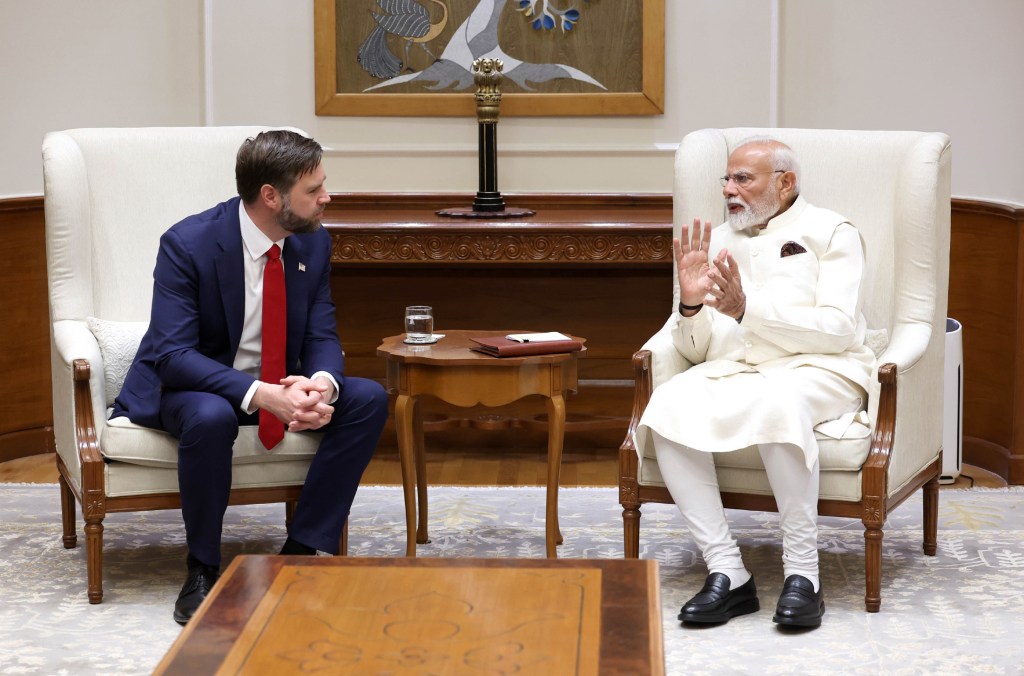
Vance and his family met Modi at his residence in New Delhi on the same day and the two leaders touted progress in trade talks between the two largest democracies. Ahead of Vance’s visit, the Indian Foreign Ministry said in a statement that the visit will help both sides review the evolution of their bilateral ties.
“And the implementation of the outcomes of the India-U.S. joint statement issued on 13 February 2025 during the visit of the Prime Minister to the US. The two sides will also exchange views on regional and global developments of mutual interest,” said the Indian statement on April 16.
Geer’s statement said Modi and Vance also announced the terms of reference for a bilateral trade agreement.
“There’s a serious lack of reciprocity in the trade relationship with India. These ongoing talks will help achieve balance and reciprocity by opening new markets for American goods and addressing unfair practices that harm American workers,” said Greer, adding that India’s engagement has been constructive so far.
Concurring with Vance’s India trip is the three-days talks beginning from Wednesday for which India’s Commerce Secretary and Chief Negotiator Rajeesh Agrawal will be in Washington with his team to further develop and discuss the trade deal.

India’s Non-Confrontational Response
Experts told The Epoch Times that India’s biggest strength during the negotiations has been its non-confrontational response to the trade tariffs announced by President Trump.
After the Trump administration announced a 26 percent tariff earlier this month on Indian goods, the Indian administration said it has no plans to retaliate.
A. Didar Singh, former Commerce Secretary of the Government of India and a former Secretary General of the Federation of the Indian Chambers of Commerce told The Epoch Times that India has done well with negotiations with the United States and more countries need to follow suit.
“Everybody feels that Donald Trump has started a tariff war that will eventually destroy America. I believe he has a hidden plan that is beyond just trade,” said Singh.
According to him India’s non-confrontational attitude has been helpful during negotiations and has been in the interest of the bilateral relations.
“Meanwhile India has done well in negotiations with the US quietly rather than confronting. This is good for India and hopefully the whole world. More countries need to follow this path,” he said.
Pathikrit Payne, a Senior Research Fellow with Dr. Syama Prasad Mookerjee Research Foundation said India’s attitude contrasted China’s and European Union’s confrontational reactions. He called non-confrontation a “strategic silence” and a “nuanced approach” and credited it to Modi’s “method of governance” and mature “foreign policy.” He said it served India’s interest while also encouraging the US for negotiations.
“Positive from the Indian side is that India maintained a kind of a strategic silence. It had a wait and watch policy. It did not immediately react to what Trump was doing, and as a result, it did not impose reciprocal tariff,” said Payne, adding that this is why India was rewarded.
Modi’s US Trip Laid the Groundwork
India’s lead among other nations in initiating a bilateral trade deal with the United States started immediately after President Trump started his second tenure in office. During Indian Prime Minister Narendra Modi’s trip to Washington in mid-February, India and the United States had already decided to more than double their bilateral trade to US$500 billion by 2030.
“The announcement [of the Terms of Reference] elevates significant work done since February 13, 2025, when Prime Minister Modi visited President Trump and the two agreed to launch negotiations for a Bilateral Trade Agreement [BTA] between the United States and India,” said the Fact Sheet on the Terms of Reference.
The two leaders during their meeting in February had announced plans for a bilateral trade agreement to ensure lesser duties and increase market access. India and US bilateral trade was $129 billion last year with a $45.7 billion surplus in India’s favour.
Harsh V Pant, Vice President of the Studies and Foreign Policy at Observer Research Foundation, New Delhi told The Epoch Times that since the February meeting, both the sides have been very focused on getting a BTA done.
“So I think the focus from both sides is now on, on getting that done, so that eventually these tariffs, how they will get structured, will be reflected in that agreement,” said Pant who is also a Professor of International Relations with the King’s India Institute at King’s College London.
Akhil Ramesh of the Honolulu based The Pacific Forum told The Epoch Times that as US-China trade war intensifies, India’s role in global value chains will become even more important.
“For New Delhi, this is an opportune time to finalize a trade deal,” he said while describing it as a unique opportunity for both India and the US.
US-China Tariff War Impacts India
Experts are of the opinion that the tariffs against India also have a geopolitical message from the United States to China. Meanwhile, that doesn’t imply that despite the positive developments in the U.S.-India trade negotiations, India will not be impacted by the U.S.-China tariff war.
“The broader challenge for India remains that if this US-China trade war, escalates, and if there is a broader weakening of the global environment, that it would impact India’s growth trajectory,” said Pant while adding that the impact won’t be as dramatic as for other countries because India’s exposure to the global environment is comparably limited and US tariffs against India are moderate.
Payne told The Epoch Times in a written reply that US moderate tariffs against India compared to its tariff war with China means that the US administration wants India to be more strategically aligned towards the US.
“They want to shift a significant part of the supply chain of critical components from China to India. And invariably, it appears that India is preferred by the Trump administration,” said Payne.
Pant said going ahead India will be watching how the global situation evolves vis-a-vis Trumps’ tariff policies.
“Will be keeping a close watch on how the broader global economy responds to this war, because India’s future growth trajectory, in some ways, is also linked to that,” he said.
Singh said the US tariff attack on China can even be interpreted as good but its impact on India will be limited because of strong India-China bilateral economic ties. India-China bilateral trade was worth $127.7 billion last year.
“We have strong economic ties with China and these will remain. Donald Trump is taking on the world economy in a bid to continue US prominence. It may work out for the best,” said Singh.
 क्षेत्रीय संवाद (Platform for Regional Discourse ) 區域對話的平台