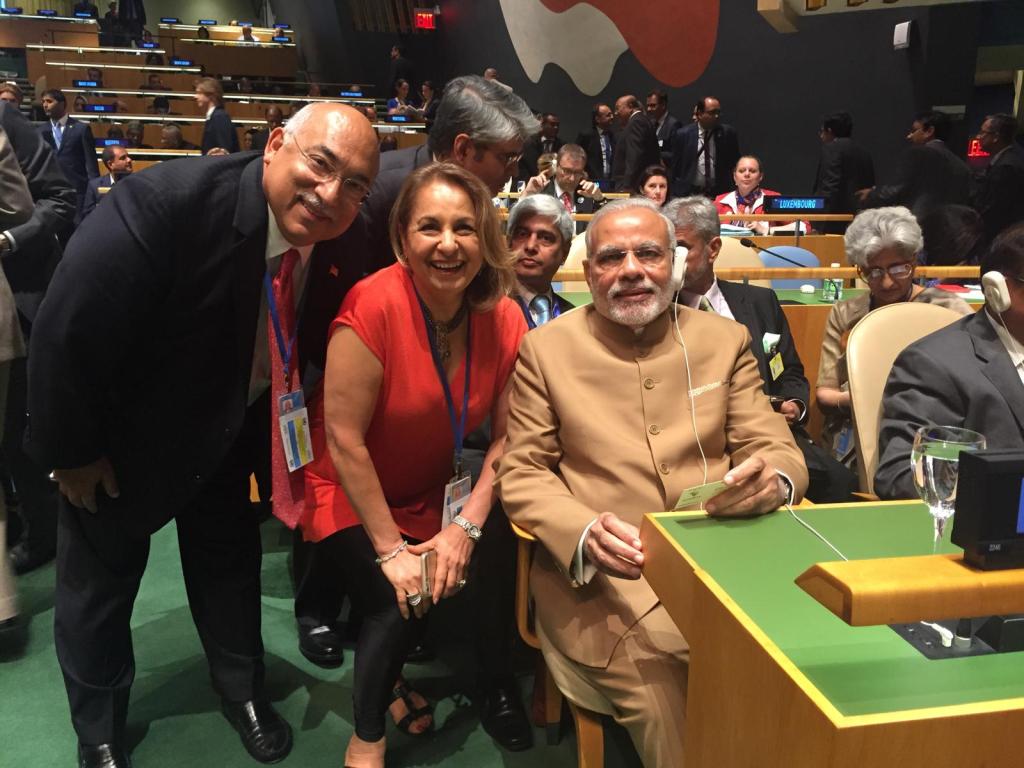
Ravi Batra is a renowned American attorney based out of New York and a long-time Chairman of the National Advisory Council of South Asian Affairs, since 2007 when he was sworn in on Capital Hill. He was the counsel to Ukraine from 2015 to 2021 and his law firm, the Law Firm of Ravi Batra, P.C. represents people, companies and presidents on various matters. Mr. Batra’s recent achievement was legally getting the mission building for Malta’s UN mission to the UN Headquarters in New York, and he was presented with the “Humphrey Bogart” Maltese Falcon in June by the Ambassador of Malta.
Mr. Batra is also the former Commissioner of New York State Joint Commission on Public Ethics (JCOPE), has been a Legal Advisor to numerous nations’ permanent missions to the U. N. since 2009, including Georgia, Honduras, India, Japan, Kiribati, Malta, Mosembique, Pakistan, Slovenia, and Sri Lanka and Ukraine. In 1988, he was a part of the U.S. Attorney General Ed Meese’s Delegation to Japan to resolve bilateral trade imbalance, and he’s the publisher and editor-in-chief of The American Times, a paper dedicated to inter-governmental diplomacy and the UN Charter.
The Indo-Pacific Politics talked with Mr. Batra about the legal context to the geopolitical dynamics between People’s Republic of China (PRC), Republic of China (ROC) and the United States and about what Taiwan can learn from the Ukraine crisis.
“The day it [PRC] realizes that its future profit, its future growth, is directly linked to being an American ally, then the problem between Mainland China and Taiwan ought to disappear, because Taiwan already is an American ally, invested as it is, with freedoms and liberties for its citizens.”
US Attorney, Ravi Batra
Indo-Pacific Politics (IPP): What’s the legal background to today’s geopolitics between PRC, ROC and US? How do you legally understand each party’s stakes?
Ravi Batra: If you want to call this entire interview into a point, I would say my one request, which is also a complaint about China, is very simple. America made China great in the 20th century. We’re not talking about 5000 years ago or 500 years ago, when the Ming Dynasty was around, but in the 20th century, after PRC’s Chairman Mao Zedong hosted President Nixon and after the Chinese Civil War ended when Chiang Kai-shek left the mainland in 1949 to go to Taiwan and set up a democracy: Republic of Taiwan, and remained a member of the P5 in the United Nations Security Council.
And you know what made PRC great was America. It was Richard Nixon in 1971 – when US voted in the Security Council and UNGA for China to be represented by PRC, in place of ROC, and got all P5 members to agree, including Taiwan agreeing to be substituted – and upon another agreement between the United States and Mao Zedong, Chairman of PRC, and that agreement [called Shanghai Communiqué negotiated during the 1972 rapprochement with China] was about “One China, Two Systems policy.” One China two systems policy could be further broken down into two systems–One being the communist system on the mainland and the other being the free capital market system.
The second system was broken up further into two, because one was Hong Kong and Macau, which was temporary, because it had an expiration date of 1997. However, the second system, relative to Taiwan, is different. Taiwan is permanent. Taiwan does not have an expiration date. And so this desire for reunification, you know, is problematic, because the agreement in 1971 that led to the United States causing PRC to replace ROC in the Security Council and gave China the keys to the kingdom–the kingdom of the world–to manage the world, along with the other four great powers, was a unique event. The legally binding consideration was that Taiwan’s free capital market system continues forever.
It was a solitary event which now has unleashed China’s growth to where it is, a number two global economy with everyone else far into the rear view mirror, not only on a currency basis, but even more on a consumption basis, product basis, its economy is now 20 trillion. So my concern, basically, is that there is no reason that Mainland China, PRC, is not a durable American ally when we made China great. The day it realizes that its future profit, its future growth, is directly linked to being an American ally, then the problem between Mainland China and Taiwan ought to disappear, because Taiwan already is an American ally, invested as it is, with freedoms and liberties for its citizens.
Every person in China ought to love the United States for the trust we gave them that they would join the free market system, that the everyday Chinese would get their version of the American dream, their version of American freedoms, which their brethren and sisters in Taiwan already enjoy in a fuller measure. So we were giving an economic transformation of China with the hope that it would cause a political embrace, if not a marriage between the PRC and the United States. So it’s a little bit troubling that instead, the drums of war can be heard in the far distance while water cannons are currently used in the Phillipines Sea and neighboring nations’ fishermen are unsafe.
“We were giving an economic transformation of China with the hope that it would cause a political embrace, if not a marriage between the PRC and the United States. So it’s a little bit troubling that instead, the drums of war can be heard in the far distance,”
US Attorney, Ravi Batra
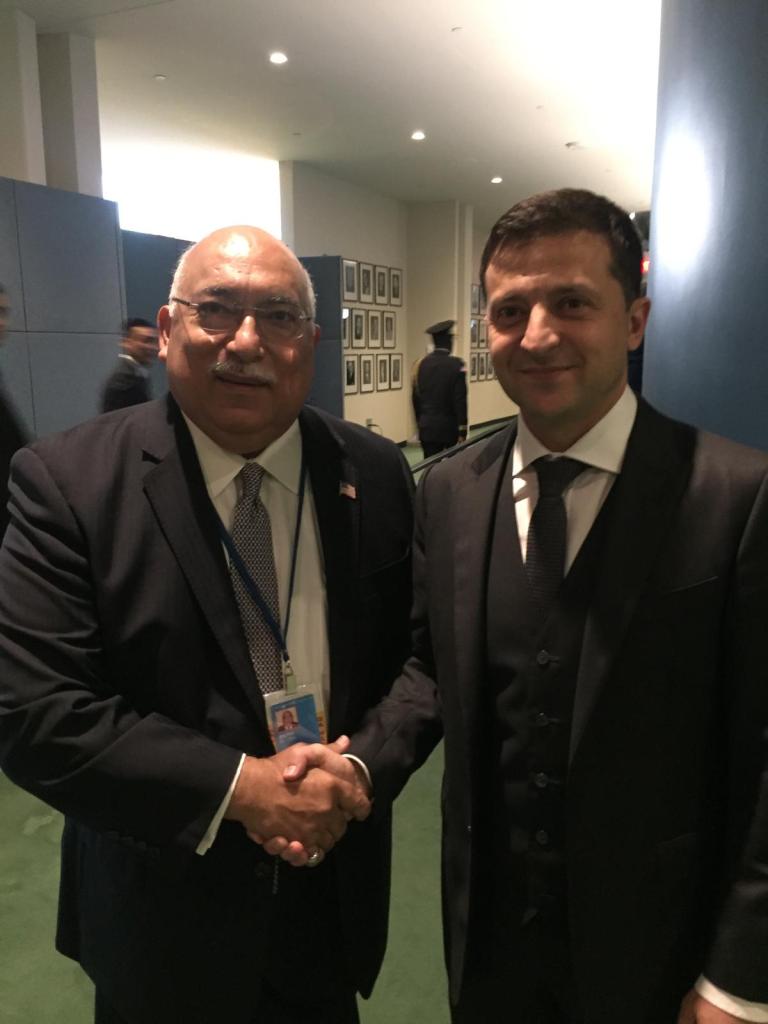
Indo-Pacific Politics (IPP): You were a counsel to Ukraine and you worked with President Petro Poroshenko and Volodymyr Zelenskyy. In 2018, you were also Global Special Counsel to Antonov, the largest aircraft manufacturing company of Ukraine and aware that China had acquired rights and technical data from Antonov in 2016 to the An-225 Mriya airlifter, the largest plane in the world. Ukraine has been in a large-scale war with Russia for three years. What can Taiwan learn from this war situation?
Ravi Batra: Ukraine and Taiwan are really completely separate and apart. Now, every war is a teaching lesson for everybody else who’s in the business of war. For example even after Operation Sindoor there was a threat of a nuclear war between India and Pakistan because both are nuclear powers but Ukraine and Russia are not the same. President Trump’s and Secretary Rubio’s role in stopping a nuclear war from erupting between Pakistan and India, is best seen by our President Trump Hosting Pakistan Army Chief Asim Munir at the White House, a First. As for Russia, it has got a huge nuclear arsenal. Ukraine has zero.
In fact, for the 1994 Budapest Memorandum when Bill Clinton was President, we went to Belarus, Kazakhstan and Ukraine and asked them to give up their nuclear weapons that were in silos hosted on their land, when they were part of the Soviet Union. Now that the Soviet Union had collapsed voluntarily in 1991 we did not want these three new young republics to have nuclear weapons. So we made a deal with them, which is the 1994 Budapest memorandum.
We told them please give up your nuclear arms and we’ll take care of you. We’ll secure you! Hence, the Budapest Memorandum is more binding than Article 5 of NATO, as that “all for one” security obligation is dues-based, while Belarus, Kazakhstan and Ukraine have their full lifetime consideration of giving up Nukes in exchange for our Security guarantee. We are obligated to secure Ukraine; and so are China, Russia, France and U. K.
It was not because there was a civil war between the former Soviet republics that was unsettled, as PRC may now believe, in an ex post facto manner, post-UNSC substitution, as to ROC. But between Ukraine and Russia, there was and is no civil war. So on that score, the predicate is wrong.
The issue between PRC and ROC is that there was an implicit settlement between the two parties, made explicit only by the United States and PRC, not by ROC, other than agreeing to the United States’ desire to substitute and ROC to remain free and secure. So it’s in 1971 that the implicit end of the Civil War in China was codified into international law by the ‘One China Two Systems Policy’ and that was done by the United States and China. So this desire of reunification across the Taiwan Straits is wrong, because that’s how PRC got the Security Council seat: to let Taiwan’s Second System live and exist forever.
The problems in geopolitics really can be simplified: that we need to make sure leaders, when they agree to a deal it’s backed up by their “sacred honor,” as our 1776 Declaration was (and is), and treat each other with mutual respect. And Leaders need to stop being covetous of their neighbors. We’ve got to let people live in harmony, rather than using internal politics that invites fear or hate of others, who too are God’s children. And, you know, a little bit of mutual respect will go a long way when combined with “walk humbly with thy God.”
“And Leaders need to stop being covetous of their neighbors. We’ve got to let people live in harmony, rather than using internal politics that invites fear or hate of others, who too are God’s children.”
US Attorney, Ravi Batra
 क्षेत्रीय संवाद (Platform for Regional Discourse ) 區域對話的平台