
By Venus Upadhayaya
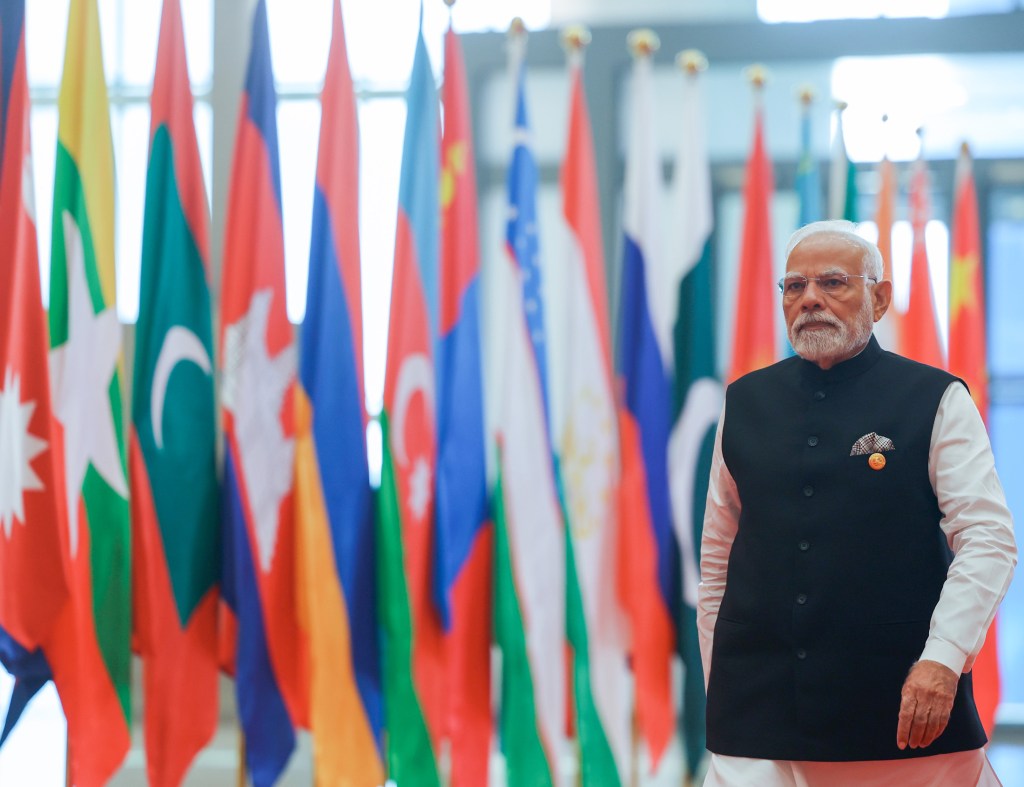
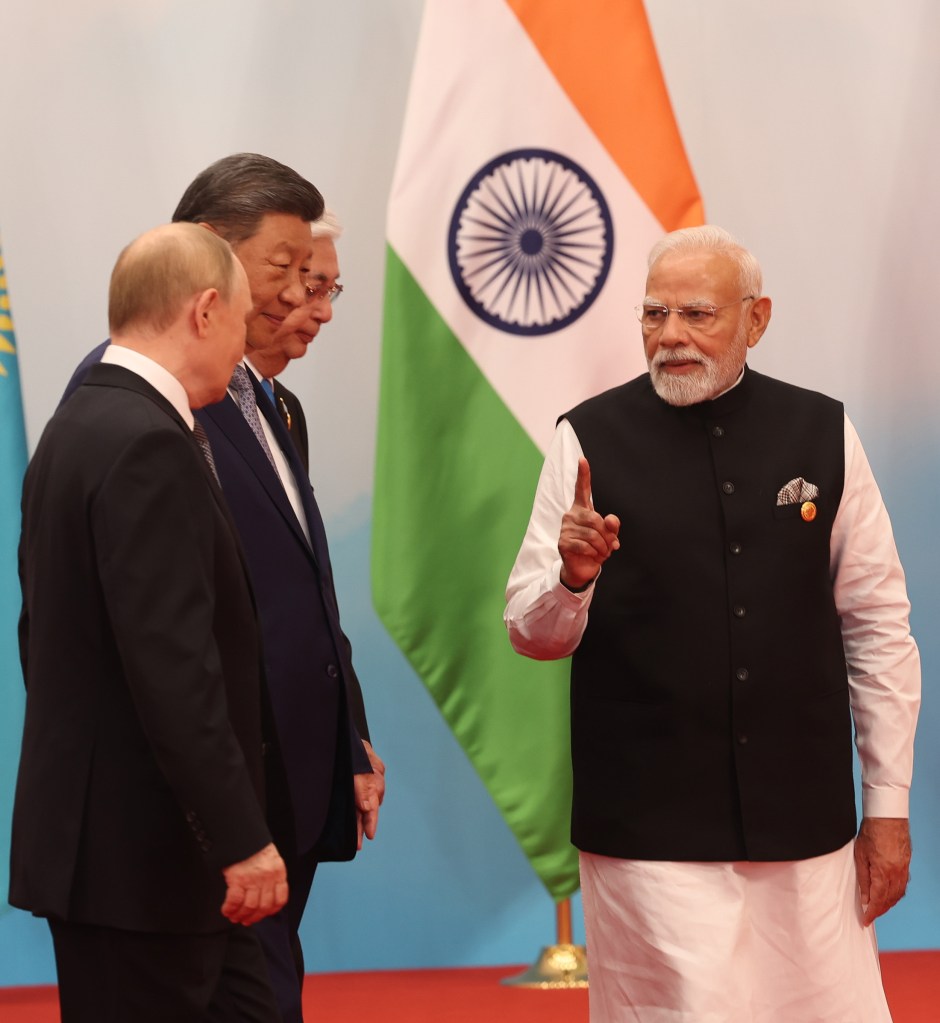
The timing of the Tianjin SCO has incidentally complemented the timing of Trump’s 50 percent punitive tariffs on India that kicked off just three days before Modi landed at the Chinese summit and met Chinese leader Xi Jinping.
There’s certainly some buzz about China coming with a hand to help India heal from the US tariff bite. There’s also a rush around interpreting what “partners not rivals” mean in the statements released after Modi and Xi’s meeting on Sunday. “Partners and not rivals” are a few common words that find a mention in statements from both sides. Trump tariffs certainly form a context to this.
“Given the great uncertainties in the world economy, it is vital for India and China to strengthen cooperation as important economies of the world,” said the statement by the Chinese Ministry of Foreign Affairs while quoting Modi.
Both the sides used the term “strategic autonomy” while emphasizing that “India and China relations should not be seen through a third country lens,” as the India side put it or “bilateral relationship is not subject to the influence of any third party,” as the Chinese side worded it differently.
There’s nothing casual in the usage of words in the official statements from both sides and it’s interesting to note the difference. While commenting on the trade between both sides, the statements by the Indian Prime Minister’s Office and the External Affairs ministry both mention the following:
“On economic and trade relations, they recognized the role of their two economies to stabilize world trade. They underlined the need to proceed from a political and strategic direction to expand bilateral trade and investment ties and reduce trade deficit.”
The Chinese side did quote Modi on developing “bilateral ties from a long-term perspective” but nowhere talked about the trade deficit which is almost 100 billion accounting for 35 percent of India’s total trade imbalance. Wonder how the two sides have such different interpretations and documentations of the same meeting!
Reality Check!
As the SCO summit came to a close on Monday, PM Modi returned to New Delhi without attending China’s victory day parade scheduled for September 3 to mark 80 years since the end of the second world war. The parade will notably have high profile attendance of Vladimir Putin and North Korea’s Kim Jong-un and Iranian president Masoud Pezeshkian!
Modi flew to the SCO summit after a successful trip to Japan. His presence and assertive messages at the SCO as well his absence from the Wednesday’s parade both leave many messages for the west as well as for the Global South. While it generally conveys the image of a self-discerning India making an effort to prioritize self-interest–India’s bilaterals with China at the SCO specifically highlight that India prioritizes a peaceful and stable border and greatly balanced trade and more investments from Beijing.
India’s grounding in realism vis-a-vis China and the United States is also happening because of Pakistan which is currently being wooed by both China and the United States. US and Pakistan announced a new agreement on July 30 for the joint development of Pakistan’s oil reserves which President Donald Trump described as a “significant beginning” to a long term energy-partnership. This was accompanied by Trump decreasing the initially announced trade tariffs for Pakistan from 29 percent to 19 percent.
Pakistan invited US companies for a fresh round of oil and gas exploration bids on August 20 and the once soured relationship between Pakistan and US is now suddenly looking promising–very antagonistic to how things have off-late shaped between India and US.
Usage of ‘Terrorism’ in SCO Statements!
Modi brought the SCO summit’s attention to April’s Pahalgam attack and got a positive response to India’s concerns in the summit declaration on Monday–however any mention of “terrorism” is missing from the Chinese statement of Sunday’s bilateral meeting while finding a mention in the India release of the same meeting. This can’t be a random omit by the Chinese!
“India has been bearing the brunt of the terrorism for the last four decades. Recently, we saw the worst side of terrorism in Pahalgam. I express my gratitude to the friendly country that stood with us in this hour of grief,” said Modi in his address to the summit on Monday.
In response while condemning the attack, the SCO declaration said: “Double standards in the fight against terrorism unacceptable.”
“The Member States strongly condemned the terrorist attack in Pahalgam on 22 April 2025. They expressed their deepest sympathy and condolences to the families of the dead and the wounded. They further stated that perpetrators, organisers and sponsors of such attacks must be brought to justice,” read the declaration.
Reflections of these were found in the statements released by the Indian side of Sunday’s bilateral meeting between Modi and Xi.
“The two leaders deemed it necessary to expand common ground on bilateral, regional, and global issues and challenges, like terrorism and fair trade in multilateral platforms,” said the Indian statements by PMO and MEA.
Indian Foreign Secretary, Vikram Misri during a press briefing confirmed that “the issue of cross-border terrorism was raised by the Prime Minister” with Xi Jinping on Sunday and the Chinese side has extended its support in various ways.
However the word terrorism doesn’t find any use in the Chinese statement of the same bilateral meeting and it’s very likely to accommodate Pakistan which India has repeatedly blamed for the Pahalgam attack. India conducted punitive strikes inside Pakistan after Pahalgam and the two sides were involved in a serious conflict in the aftermath.
What’s more notable is a Chinese statement of August 22 of the meeting between Chinese Foreign Minister Wang Yi and Pakistan’s Field Marshal Syed Asim Munir. Wang Yi flew to Pakistan after his meeting with Indian External Affairs Minister Subrahmanyam Jaishankar in New Delhi.
The Chinese statement of the meeting between Wang Yi and Asif Munir talked about “jointly building an upgraded Version 2.0 of the China-Pakistan Economic Corridor with high quality. Making positive contributions to accelerating the building of a closer-Pakistan community with a shared future in the new era.”
Wang Yi also talked about China and Pakistan “both belonging to the Eastern civilization” which he talked with Jaishankar as well.
In the changing scheme of things India is aware that both the US and China will not unconditionally support its rise and there’ll be costs to pay and repeated self-assertions required. And that’s where India’s relation with Russia becomes important.
This puts India in a unique situation to help stop the war between Russia and Ukraine. Ukrainian President Volodymyr Zelensky identifies this and that’s why he called Modi on Saturday before the latter flew to Tianjin. Earlier Putin had also called Modi–before and after his Alaska meeting with Trump.
It needs to be seen how India manages to balance well between Ukraine and Russia while countering the US claims of fueling the war! Both China and the US are watching India and Modi.
Venus Upadhayaya is a MOFA 2025 Taiwan fellow and a visiting scholar at the College of Law and Politics at NCHU Taichung. This is first in a syndicated series on “Mid-2025 and a Global-Shift”.
 क्षेत्रीय संवाद (Platform for Regional Discourse ) 區域對話的平台