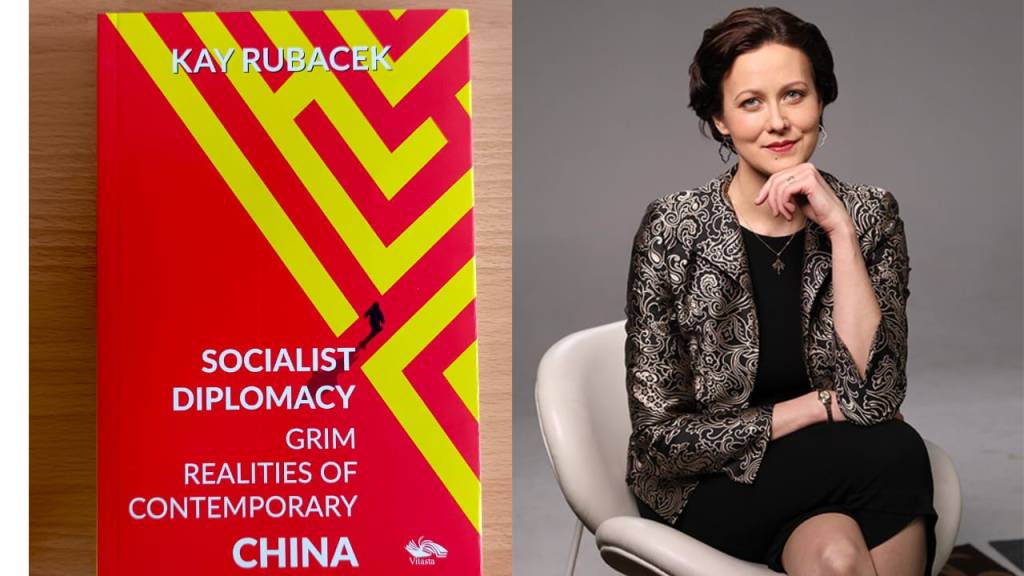
Kay Rubacek is an author, filmmaker, and human value advocate with over 25 years of experience in media and communications. She is the author of Who Are China’s Walking Dead? (published in India as Socialist Diplomacy, Grim Realities of Contemporary China) and the newly released Chinese Dragons: The Mythical Creature Art Book. Her award-winning documentaries Finding Courage and Hard to Believe have exposed human rights abuses in China, including the persecution of families and the crime of forced organ harvesting.
Rubacek’s perspective is deeply personal: her family escaped communist regimes three times across Europe and Asia, and she herself was imprisoned in China for her work exposing state abuses. This lived experience fuels her mission to connect geopolitics, culture, and human dignity, offering insights into China’s role in the Indo-Pacific and the global struggle for freedom.
The Indo-Pacific Politics talked with Kay Rubacek about her new books and about a few fundamental questions behind the tensions between China and Taiwan.
The Indo-Pacific Politics: Your book ‘Who are China’s Walking Dead?’ was published in India as ‘Socialist Diplomacy, Grim Realities of Contemporary China’. Tell us more about your book and why it’s important in the geopolitical context of 2025?
Kay Rubacek: My book looks at what happens to human beings when an authoritarian system systematically strips away their individuality, conscience, and voice. The “walking dead” are not just a metaphor, they’re real people whose humanity has been hollowed out by a political system that demands absolute conformity. In 2025, when China is both deeply integrated into the global economy and simultaneously a growing geopolitical threat, the book matters because it shows what’s behind the façade of China’s “rise.” It’s not simply about military power or trade wars, it’s about human value, or the lack of it, as the foundation of state policy. That’s a reality policymakers can’t afford to ignore.
The Indo-Pacific Politics: As a journalist, author and filmmaker, how do you fathom the China-Taiwan political context? What should the world know about this China-Taiwan equation that it has missed until now?
Kay Rubacek: When people talk about China and Taiwan, they often frame it as a military standoff or a diplomatic chess match. What’s less understood is the human and cultural dimension. Taiwan represents a version of Chinese culture that preserved freedom of thought, creativity, and belief. These are things that have been severely repressed on the mainland. The China–Taiwan equation isn’t just about borders, it’s about two very different futures for what it means to be “Chinese.” If the world sees this only through the lens of geopolitics, it misses the deeper story that this is a contest over human dignity and cultural continuity.
The Indo-Pacific Politics: You are a researcher in Chinese culture and civilization and you recently released your book ‘Chinese Dragons–the Mythical Creature Art Book’. What’s core to Chinese civilization and what went missing that needs to be revived and re-cultivated?
Kay Rubacek: Chinese civilization has always been rooted in spirituality and harmony between heaven, earth, and humanity. That balance is expressed in myths, art, rituals, and in how people related to family and community. What went missing under communism was the spiritual heart of that civilization — the idea that life has meaning beyond the state. With Chinese Dragons, I wanted to explore one of the most enduring symbols of Chinese culture. The dragon is not just a “mythical creature,” it embodies wisdom, power, and protection. Reviving these symbols isn’t nostalgia, it’s about reconnecting with the moral and imaginative foundations that allowed Chinese civilization to endure for millennia.
The Indo-Pacific Politics: Tell our readers about your two award winning films–Finding Courage and Hard to Believe. What can they give to viewers in 2025? Are you currently working on any new film?
Kay Rubacek: Both films focus on ordinary people confronting extraordinary injustice. Hard to Believe investigates forced organ harvesting from prisoners of conscience in China — a crime that still demands accountability today. Finding Courage follows one family’s struggle for freedom and truth after persecution. In 2025, these films remind us how quickly human rights can be eroded when the value of the individual is subordinated to ideology or profit.
As for new projects: yes, I’m continuing to develop films, but also expanding into new formats—video essays, series, and books—that can reach wider audiences. My focus remains the same: telling stories that expose hidden systems while affirming the resilience and worth of human beings.
The Indo-Pacific Politics: Is there anything else that you would like to share with our readers?
Kay Rubacek: If there’s one thread running through all my work, whether it be in books, films or podcasts, it’s that human value matters. Whether we’re talking about geopolitics, technology, or culture, the greatest danger is when people start to believe they are powerless, replaceable, or less than human. That’s when systems of control win. My message to readers is simple: you have more value and more resilience than you’ve been told. Reclaim that, and no regime, algorithm, or ideology can take it away.
 क्षेत्रीय संवाद (Platform for Regional Discourse ) 區域對話的平台