‘If Taiwan falls, so does the US-led world order in the region at least. Or more importantly, it will be the end of the democratic world order as we know it.’
Dr. Amlan Dutta, Geo-political Analyst
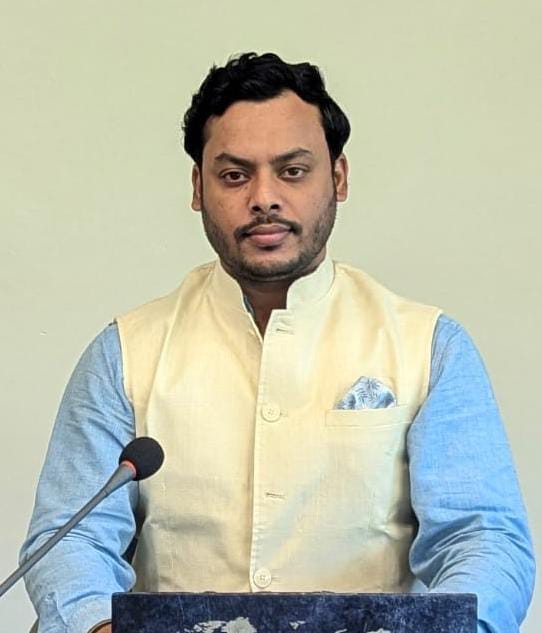
Dr. Amlan Dutta is a Junior Fellow at the Prime Minister’s Museum and Library (PMML), Teen Murti House, New Delhi, where he is working on India’s policy towards East Asia and the Indo-Pacific. He was formerly an Assistant Professor at the Rashtriya Raksha University (An Institution of National Importance), Ministry of Home Affairs, Government of India. He has done his PhD at the Department of East Asian Studies, University of Delhi. His thesis was on Japan’s domestic politics and Japan’s foreign policy with focus on East Asia.
The Indo-Pacific Politics conversed with Dr. Amlan Dutta about the changing scheme of things in the Indo-Pacific region, the importance of Taiwan and QUAD in this context and what can be expected from China in the region in the next five years.
The Indo-Pacific Politics: Do you see a shift in the geo-political matrix of the Indo-Pacific? What’s significant about it?
Dr. Amlan Dutta: The current geopolitical focus of the world has shifted towards what I would like to call the ‘tariff hegemony’ of the US under President Donald Trump which has subsequently allowed the likes of China to automatically attract much of the ‘affected’ nations into its orbit, including India. Although a binary reading of the situation would be too simplistic for a nuanced understanding of the current happenings, yet the significance of the non-Western world collectively standing up to US’ ‘bullying’ in search of an alternate World Order should not be missed.
It is truly an inflection point in global politics, nothing like since the end of the Cold War. In fact, scholars of International Relations have termed this as Cold War 2.0, only for Russia to be replaced by China. It is in many ways the return of the ‘Great Power Rivalry’ with the difference being that today it is China (and not Russia) with both its expanding military and deep pockets jostling for influence worldwide. The churnings, of course, will be felt in the Indo-Pacific theater. Perhaps it is in the Indo-Pacific, where the competition between a more inward-looking US and its competitor China, which has global ambitions, is the fiercest.
Plus, with the active involvement of Middle Powers like India, Japan, Australia and ASEAN, it is in the Indo-Pacific where the contours of the New World order which is emerging fast shall be re-designed. Hence, no other global theater will be as significant as the Indo-Pacific.
The Indo-Pacific Politics: How is Taiwan placed in this context? How is it impacted?
Dr. Amlan Dutta: Despite being heavily overlooked, especially in Indian strategic and academic discussions, Taiwan is one of the most important pillars in the new Indo-Pacific powerplay. It is central to the Indo-Pacific question. If Taiwan falls, so does the US-led world order in the region at least. Or more importantly, it will be the end of the democratic world order as we know it. Taiwan’s fate and future is directly entangled with those of the Indo-Pacific theater as a whole.
All the nations which call for a ‘Free, Open and Inclusive Indo-Pacific’ (FOIP) and have been actively championing the cause of open ‘Sea Lanes of Communications’ (SLOCs) must (continue to) treat Taiwan as a priority and safeguard it with every mean at their disposal against China’s proposed goal of ‘unification by force’. Taiwan should be allowed to continue to thrive as a modern, industrialised state and a successful democracy. It should be viewed as a model state if any, and not just as a territory to be gobbled up by expansionist powers.
‘Taiwan should be allowed to continue to thrive as a modern, industrialised state and a successful democracy. It should be viewed as a model state if any, and not just as a territory to be gobbled up by expansionist powers.’
Dr. Amlan Dutta, Geo-political Analyst
The Indo-Pacific Politics: How did US trade and tariffs impact the Indo-Pacific, particularly the QUAD?
Dr. Amlan Dutta: With the next Quad Leaders’ Summit to be held in India and with various media reports citing that President Trump might give it a miss, this does not augur well for the Indo-Pacific. However, despite the ‘cold politics’ and the very obvious bad optics, I feel that the strategic importance of the Indo-Pacific and the necessity to safeguard it is not lost on anyone, including both India and the US.
In fact, the Indo-Pacific will continue to remain one of the few areas where the likes of both India and the US will continue to cooperate and see eye-to-eye, if not by personal choice than by utmost necessity for sure. Containment of China and checking China’s expansionist drives is common in the current and long-term strategies of both India and the US.
That does not mean India will be a part of any de-facto anti-China military alliance in the Indo-Pacific. I mean, this is one aspect which the Chinese will be very keen to ensure from India’s part given the fact that now we have some sort of India-China Detente. But still, the Indo-Pacific will continue to be an extremely important region in both India’s and the US’ strategic calculus and their cooperation in this domain will only expand and diversify.
With regards to the Quad and its immediate future, it remains to be seen how the political ends of the relationship hold up with two strong nationalist and populist leaders in PM Modi and President Trump at the helm and neither willing to blink at the moment. But with regards to India’s relationship with the two other members of the Quad, i.e., Japan and Australia, I mean, we just saw a very successful visit of PM Modi to Japan where the Indo-Pacific figured prominently in the bilateral discussions.
And about India-Australia relations, it is at a very positive stage and both the nations see a great deal of strategic convergence in their vision of the Indo-Pacific.
The Indo-Pacific Politics: What do you think about the strategic triangle between Taiwan, Philippines and Japan?
Dr. Amlan Dutta: Since the Quad has not emerged as a quasi-military alliance as the US or even Japan and Australia would have hoped, or to put in other words that since India has not allowed the Quad to become a military alliance or military pact of sorts, the scope of such an alliance is there and the US would be very keen to see it to fruition.
With both the Philippines and Taiwan and even Japan for that matter face a direct threat of Chinese aggression, especially from the PLAN [People Liberation Army Navy], there has been increasing talks in some circles of enhanced security and strategic coordination among them. Philippines has been actively thwarting the Chinese Coast Guard and its ‘bullying’ ever since the 2016 ruling of the Permanent Court of Arbitration in its favour.
In fact, even India has sold its most-coveted Brahmos missiles to the Philippines, making it the first international buyer of the missiles. With regards to Taiwan though, I don’t think it would be much interested in becoming any sort of player in the wider security architecture of the region. It knows that it needs to focus more on the defense of its shores first and foremost, especially now more than ever given the unpredictability and ambiguity of the US security umbrella.
Taiwan ‘knows that it needs to focus more on the defense of its shores first and foremost, especially now more than ever given the unpredictability and ambiguity of the US security umbrella.’
Dr. Amlan Dutta, Geo-political Analyst
The Indo-Pacific Politics: How’s India’s strategic interest entangled with this strategic triangle?
Dr. Amlan Dutta: If by strategic triangle you mean Taiwan, Philippines and Japan, India will be very interested in observing how it develops and what kind of working module the three nations put up on the table. I think what New Delhi will be keenly observing is whether an out-an-out anti-China military alliance will stand the test of time, not the least because China is the largest trading partner of all the three countries.
Speaking strictly about India, the call for India to play the role of a ‘Net Security Provider’ in the Indo-Pacific has only grown stronger with various countries including Japan and the Philippines making a case for a more prominent Indian naval presence in their waters. I mean India-Japan strategic cooperation in the Indo-Pacific is among the most important for both New Delhi and Tokyo. And not only that, both India and Japan intend to not only safeguard and promote democratic ideals and values and thwart expansionism in the region, but also intend to put jointly forward an alternate vision, or an alternate model of development in the Indo-Pacific.
With regards to the Philippines, India selling Brahmos to the Philippines navy is testament to the growing synergy in terms of defence and security between the two nations. India has also extended its ‘Line of Credit’ to the Philippines to purchase more defense equipment from it. What I also see is that there will increased India-Philippines joint patrols in the South China sea which automatically means enhanced levels of cooperation between the two navies.
Talking about Taiwan, India will definitely want Taipei to develop an even stronger deterrent force against China in case the latter decides to make any move. But I don’t think India in this case will move much closer to Taiwan until and unless the US is directly involved. But even in that case, I don’t see India significantly enhancing its security cooperation with Taiwan, at least not very openly.
But I must also mention that the importance of Taiwan as a security partner has actually caught the imagination of New Delhi very recently with three former Indian Defence Chiefs having visited Taipei in 2022. But in case of a new world order which as we speak seems to be emerging very fast, New Delhi will be wary of not crossing any red line with Beijing.
The Indo-Pacific Politics: What kind of behaviour do you expect from China in the South and East China Seas in the next five years?
Dr. Amlan Dutta: For some years now, we have heard many commentators and military strategists saying that the Russian invasion of Ukraine has provided China with a golden window of opportunity to invade Taiwan and fulfil its stated objective of re-unification of Taiwan with the Mainland.
Although its easier said than done, because Taiwan too today possesses significant deterrence capabilities and will surely make it very costly for China in case the latter decides to do it. But what we can definitely expect from Beijing is that it will increase its bellicose behaviour and continue to bully the smaller nations in both South and East China Seas in the coming period.
Its claims with regards to its nine dash line will intensify and it will continue with its campaign of sustained pressure towards the other claimant states. One significant aspect of Chinese aggression which should also alarm India is the breakneck speed with which it is building artificial islands in the South China Sea, which, of course, have military usage capabilities.
For India, the worst case scenario will be China indulging in such an island building spree in the Indian Ocean near the waters of let’s say Maldives, or even Sri Lanka, or even in the Bay of Bengal (read Bangladesh). So, I don’t see China taming down but rather it getting even more aggressive in the coming years.
 क्षेत्रीय संवाद (Platform for Regional Discourse ) 區域對話的平台