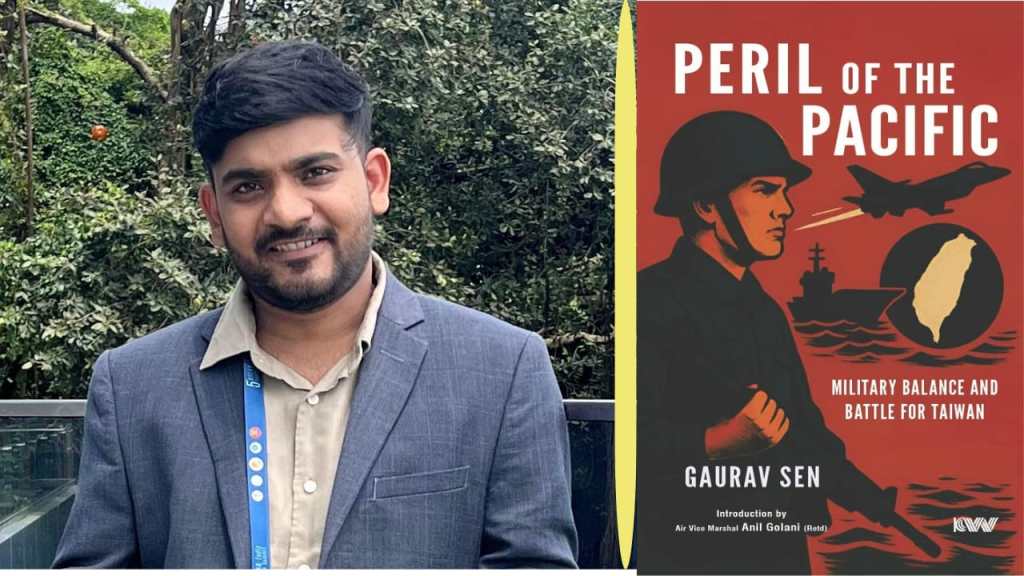
Gaurav Sen is an international relations scholar and analyst specializing in the Indo-Pacific, strategic affairs, and Taiwan. He is a Senior Research Fellow at the School of International Studies, Jawaharlal Nehru University, New Delhi, and also teaches at the University of Delhi. He has contributed to leading think tanks, including to the Indo-Pacific Studies Centre and to the Centre for Air Power Studies, and is the author of book–The Peril of the Pacific: Military Balance and Battle for Taiwan.
The Indo-Pacific Politics interviewed Gaurav Sen about the changing Indo-Pacific region, the relevance of the QUAD alliance in the changing context, the situation facing Taiwan and the evolving India-Taiwan ties. The author has also offered an in-depth insight on Taiwan’s current strategic status vis-a-vis China and these comments are particularly noteworthy.

The Indo-Pacific Politics: Do you see a dynamic shift in the Indo-Pacific region? How does it impact QUAD, and what kind of impact does it have on Taiwan?
Gaurav Sen: Indeed, China’s assertiveness, America’s reshaped approach, and the rising influence of regional actors like India, Japan, and Australia have transformed the region. This shift extends beyond the military sphere to include technology and supply chains, as well as competing visions of the rules-based order.
For the QUAD, there is an upside and downside to these developments. On the upside, the QUAD has emerged as an agile mechanism for increased responsiveness, whether towards addressing maritime security, infrastructure, or the latest technology. On the downside, the member states continue to articulate divergent threat perceptions: India has a partially continental focus, while Japan and Australia are anchored to the United States, whose own geopolitical posture oscillates with domestic politics. Thus, the QUAD is certainly much stronger than a decade ago, but it remains a concert of democracies rather than a formal alliance.
This is the point when the Trump factor is important. Although the Indo–Pacific security architecture has been carefully developing for the last twenty years, it now appears to be under strain. Trump’s transactional approach, in which friends and enemies were treated the same, has unsettled partners in the region. The most dangerous wager has been placed on India. Historically cautious about partnerships, India had begun to move closer to the QUAD and even to indirect engagement with Taiwan. However, Trump’s antics have driven India away from any serious possibility of translating that cooperation with the QUAD into a sustainable military balance against China.
This undermines the momentum of the QUAD and further increases Taiwan’s isolation in an already unstable region. To sum up, the Indo–Pacific region is increasingly contested, and the QUAD is under strain. Taiwan, the center of this turbulence, is benefiting from the regional focus on resilience and support for democracy but is increasingly exposed to the unpredictability of shifting American policy.
“The Indo–Pacific region is increasingly contested, and the QUAD is under strain. Taiwan, the center of this turbulence, is benefiting from the regional focus on resilience and support for democracy but is increasingly exposed to the unpredictability of shifting American policy.”
Gaurav Sen, Geopolitical Analyst
The Indo-Pacific Politics: Reviews of your book mention that there’s a shifting military balance across the Taiwan Strait. Can you elaborate upon that?
Gaurav Sen: The military balance across the Taiwan Strait has indeed shifted quite significantly, and this development is arguably among the most important occurring in the Indo-Pacific.
If we go back twenty years, Taiwan had a qualitative advantage: its forces were better trained, were equipped with modern Western gear, and had confidence that U.S. intervention would tip the balance in its favour. Although improvements were made, the PLA remained a predominantly land-based military power that was not particularly good at coordinating air and naval operations.
That picture is very different today. China is investing heavily in the construction of a modern military. The country has spent on building naval powers, a blue-water-capable fleet, fighter aircraft, hypersonic and precision-strike missiles, and electronic and cyber warfare capabilities. China’s A2/AD strategy now risks those U.S. bases and carriers and will alter Washington’s intervention calculus. China now outnumbers the U.S. in most military domains.
But Taiwan has not stood still. Due to its inability to compete with China in a platform-to-platform manner, Taipei has adopted an asymmetric defence. These include mobile missile units, fast attack craft, drones, sea mines, and civil defence. All of these will complicate any invasion plan and raise the price tag for Beijing. Taiwan is improving its security ties with partnered countries, even if unofficially. More importantly, it is using its semiconductor industry as leverage to garner international attention for its security.
Taiwan’s ability to withstand aggression and U.S. and regional interest in preserving the status quo are enough to deny the PLA the advantage it needs, even though China is clearly in the driver’s seat and has the upper hand in conventional terms. This makes the Strait a high-risk zone in military and political and strategic terms, given the danger that a miscalculation can escalate the situation to the regional level.
In other words, the balance has swung towards China but has not yet crossed over the tipping point. The strategy of Taiwan and the wider regional response ensures that deterrence is still intact, but it is becoming more fragile year on year.
“Taiwan has not stood still. Due to its inability to compete with China in a platform-to-platform manner, Taipei has adopted an asymmetric defence.”
Gaurav Sen, Geopolitical Analyst
The Indo-Pacific Politics: How are Taiwan’s technological advancement and semiconductors integral to its national security?
Gaurav Sen: Taiwan’s technological advancement, particularly in semiconductors, is not just an economic asset; it is a pillar of its national security. The island produces more than 60% of the world’s semiconductors and over 90% of the most advanced chips. This dominance has created what many call Taiwan’s “silicon shield”.
The idea is simple: because global industries and militaries—from smartphones to fighter jets—depend on chips made in Taiwan, the world has a direct stake in its security. For Taiwan, semiconductors serve three national security functions. First, they act as a deterrent. China understands that any conflict disrupting chip production would cause global economic shockwaves, potentially isolating Beijing as much as Taipei. Second, they give Taiwan strategic leverage with major powers like the United States, Japan, and Europe, all of whom are invested in supply chain security. This creates indirect political support for Taiwan, even among countries that do not formally recognise it.
Third, semiconductors are at the heart of military technology from AI to missile guidance systems—so Taiwan’s own access to advanced chips strengthens its defence capabilities. Of course, this is not without risks. Taiwan’s chip sector also makes it a strategic target for China, which has invested heavily in trying to localize semiconductor production. So, while semiconductors provide Taiwan with a shield, they also place it at the center of great-power competition. In short, Taiwan’s technological edge, especially in semiconductors, is both its greatest vulnerability and its greatest source of security—tying its survival to the interests of the broader international community.
“So, while semiconductors provide Taiwan with a shield, they also place it at the center of great-power competition.”
Gaurav Sen, Geopolitical Analyst
The Indo-Pacific Politics: How do you judge India-Taiwan relations in 2025 and what’s its future? After the Galwan incident, has a strategic link developed between what happens across the Taiwan strait with China’s activities on India’s border?
Gaurav Sen: India–Taiwan relations in 2025 remain what I would call strategically cautious but substantively expanding. Since the 1990s, the relationship has been framed as “non-official” cooperation, but in practice, it has deepened significantly in trade, technology, education, and people-to-people links. Taiwan is now an important partner for India’s semiconductor and electronics ambitions, while India offers Taiwan a large market and a geopolitical partner outside China’s orbit.
What’s striking in 2025 is that both sides are finding creative ways to strengthen ties—through technology cooperation, academic exchanges, and supply chain diversification—without crossing the red lines of formal diplomacy. The shadow of Galwan in 2020 is critical here. That clash fundamentally reshaped India’s threat perceptions of China, moving from a competitive coexistence to outright confrontation.
Since then, New Delhi increasingly sees the Taiwan Strait and the Himalayas as part of a linked strategic theater: China’s assertiveness is not compartmentalised but systemic. A Taiwan crisis would directly affect India by tying down U.S. and allied forces, emboldening Beijing to apply pressure along the Line of Actual Control. Conversely, Chinese coercion on India’s border weakens New Delhi’s ability to contribute to broader Indo-Pacific stability. This sense of interconnection has grown much sharper in India’s strategic discourse.
Looking ahead, I would say the future of India–Taiwan relations will be shaped by two factors. First, India’s semiconductor and critical technology push almost guarantees deeper engagement with Taiwan, because Taipei holds irreplaceable expertise. Second, India will calibrate this engagement against its management of the China challenge. It is unlikely to recognise Taiwan formally, but it will continue to signal that Taiwan’s security is not irrelevant to India’s own. The relationship, therefore, will grow more strategic in substance, even if the label remains “non-official”. India and Taiwan are not allies, but they are becoming important partners, and post-Galwan, India increasingly views what happens in the Taiwan Strait as part of the same strategic equation it faces on its northern borders.
“Post-Galwan, India increasingly views what happens in the Taiwan Strait as part of the same strategic equation it faces on its northern borders.”
Gaurav Sen, Geopolitical Analyst
The Indo-Pacific Politics: How do you see China’s activities in the South China Sea in the coming decade?
Gaurav Sen: In the coming decade, China’s activities in the South China Sea will be characterised by steady consolidation rather than dramatic moves. We are likely to see the deepening of military and dual-use infrastructure on reclaimed features, more frequent patrols by its coast guard and maritime militia, and the normalisation of coercive tactics such as shadowing and water-cannoning against other claimants. This strategy is meant to make de facto control feel routine while avoiding the kind of outright seizure that would provoke overwhelming pushback.
At the same time, Beijing will integrate advanced technologies—sensors, missiles, cyber and electronic warfare—into a layered defense network that effectively turns the South China Sea into a basin of surveillance and strike capability. The implications are clear: Southeast Asian claimants like the Philippines and Vietnam will face growing pressure but will also deepen ties with external partners such as the U.S., Japan, India, and Australia. Freedom of navigation operations and joint patrols will become more regular, raising both deterrence and the risk of accidental clashes.
Economically, any disruption in this critical waterway will reverberate globally, making international stakeholders more engaged in preserving stability. In short, China will not stop pressing its advantage, but the region’s response will determine whether the South China Sea becomes a controlled Chinese lake or a contested but open maritime commons.
The Indo-Pacific Politics: Is there anything else that you wish to share with our readers on this topic?
Gaurav Sen: I would just say these are very interesting times for the Indo-Pacific. It’s not only about big powers competing but also about how technology, supply chains, smaller states, and even values come together in this region.
For those of us studying it, the challenge is to keep our work relevant, not just analyzing what’s happening, but asking what it means for the future. Because in many ways, what happens here will set the tone for the global order in this century.
 क्षेत्रीय संवाद (Platform for Regional Discourse ) 區域對話的平台
One response to “There Are ‘Competing Visions of the Rules-Based Order’ in the Indo-Pacific: Author”
A very interesting take! Indeed insightful!
LikeLike