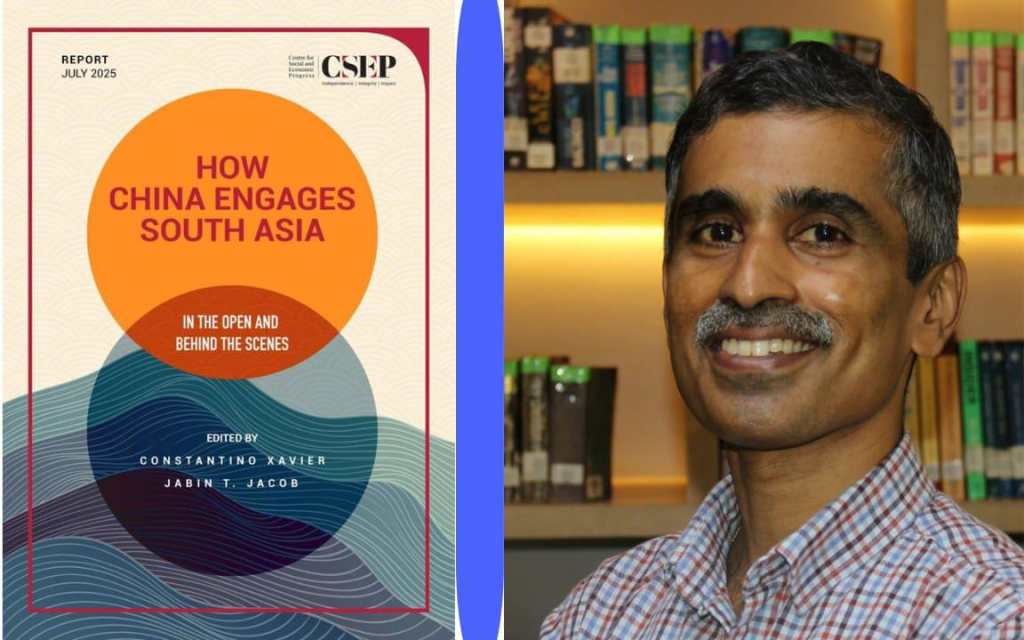
Jabin T. Jacob is an Associate Professor, Department of International Relations and Governance Studies, and the Director of the Centre of Excellence for Himalayan Studies, Shiv Nadar University, Delhi NCR. He was formerly Fellow and Assistant Director at the Institute of Chinese Studies. He holds a PhD in Chinese Studies from the School of International Studies, Jawaharlal Nehru University, New Delhi and has spent time as a student / researcher / faculty in Taiwan, Singapore and France.
Jacob’s research interests include Chinese domestic politics, Sino-Indian border areas, Indian and Chinese worldviews, and centre-province relations in China. Jacob’s latest publications include, two co-edited special issues for the China Report journal on the Communist Party of China’s 100th anniversary (February 2022 and August 2022) as well as two volumes on How China Engages South Asia titled respectively, Themes, Partners and Tools (2023) and the recently released In the Open and Behind the Scenes (2025) for the Centre for Social and Economic Progress, New Delhi. Some of his work can be found at https://indiandchina.com/
The Indo-Pacific Politics talked with Jabin T. Jacob about US-Taiwan and Taiwan-India relations. His comments on why Taiwan is important for India in 2025 and how India “expanded its position a bit further” on Taiwan during Chinese Foreign Minister Wang Yi recent trip to New Delhi are particularly noteworthy.

The Indo-Pacific Politics: Why is Taiwan important for India in 2025? Has the recent visit by Wang Yi to New Delhi and the visits of PM Modi to Japan and to SCO at China impacted India’s approach towards Taiwan?
Jabin T. Jacob: Taiwan is important to India primarily from an economic and technological development perspective. Secondarily, Taiwan is also a source of information and analysis on China, a common challenge.
The visit by Chinese Foreign Minister Wang Yi to New Delhi occasioned some talk about Taiwan in each country’s statement on the visit. While China indicated that India had affirmed the ‘one China’ policy, India chose the occasion to expand its position a bit further. While it declared that ‘there was no change in India’s position’, it also stated that ‘like the rest of the world, India had a relationship with Taiwan that focuses on economic, technological and cultural ties and that this would continue’.
For good measure, the Indian side declared that it had pointed out ‘that China also cooperates with Taiwan in these very domains’. This is actually a case where India made use of the occasion to highlight its interests in Taiwan.
“While China indicated that India had affirmed the ‘one China’ policy, India chose the occasion to expand its position a bit further. While it declared that ‘there was no change in India’s position’, it also stated that ‘like the rest of the world, India had a relationship with Taiwan that focuses on economic, technological and cultural ties and that this would continue’.”
Jabin T. Jacob, Author & Analyst
The Indo-Pacific Politics: On Sep. 9, Secretary of War Pete Hegseth spoke with China’s Minister of National Defense, Admiral Dong Jun and among the other things the two discussed, Hegseth spoke about US’ “Vital interests in the Asia-Pacific, the priory theater“ and said that US will “resolutely protect those interests.“ Do you see a shift in the US Indo-Pacific policy to Asia-Pacific Policy?
Jabin T. Jacob: I don’t see a shift – communication between the two militaries is essential for preventing miscalculations and the US side has constantly emphasised the need for such communication. It is the Chinese side that has chosen to limit engagement.
The Indo-Pacific Politics: How’s Taiwan critical for US Asia-Pacific policy in 2025?
Jabin T. Jacob: Taiwan is critical not just for economic or technological reasons but because if it falls to military coercion by China, that would mean the end of the credibility of the US in the Indo-Pacific and the wider world.
The Indo-Pacific Politics: How do you see Trump’s trade and tariff policies impacting the Indo-Pacific region and QUAD?
Jabin T. Jacob: These have certainly raised questions about US reliability and created a very poor image of the US as an untrustworthy and unreliable partner that continues with its hegemonic practices.
However, most governments in Asia would rather do business with the US in the hope that it will eventually mend its ways than with China where political and economic pressure in bilateral ties are both certain and likely to be constant.
Trade and tariff policies “have certainly raised questions about US reliability and created a very poor image of the US as an untrustworthy and unreliable partner that continues with its hegemonic practices.”
Jabin T. Jacob, Author & Analyst
The Indo-Pacific Politics: How do you see India’s strategic interests evolving in the Indo-Pacific in the next five years?
Jabin T. Jacob: India’s strategic interests in the Indo-Pacific are dependent on its domestic conditions. Without large-scale economic and social reforms, India is not going to be able to work to its potential.
It will still achieve a great deal due to the sheer size of its economy as well as military but it will not achieve as much as it ought to.
 क्षेत्रीय संवाद (Platform for Regional Discourse ) 區域對話的平台