By Aditya Shrivastava/The Indo-Pacific Politics
India-Taiwan relations have steadily matured since the mid-1990s, marked by economic engagement, pragmatic collaboration, and quiet diplomacy amid the One-China policy constraints. While India does not formally recognize Taiwan diplomatically, both sides maintain representative offices the India-Taipei Association in Taipei and the Taipei Economic and Cultural Center in New Delhi and Mumbai serving as de facto embassies. This pragmatic relationship centers on trade, investment, technology, education, and people-to-people ties.
Bilateral trade volumes have surged in recent years, reaching $10.6 billion in 2024, with upward momentum expected to breach new records in 2025. Around 200 Taiwanese companies operate in India, investing primarily in electronics, hardware, automotive, construction, and chemicals. Conversely, India has become an attractive market for Taiwanese exports, particularly in electronic components, semiconductors, and industrial machinery.
Technology particularly the semiconductor industry has become a major pillar of bilateral cooperation. Taiwan is a global semiconductor manufacturing hub, producing nearly 90% of the world’s advanced chips. Recent flagship projects, such as the $11 billion Tata Electronics–Powerchip Semiconductor Manufacturing Corporation (PSMC) joint venture in Gujarat, underscore the deepening technology partnership.
Recent Developments
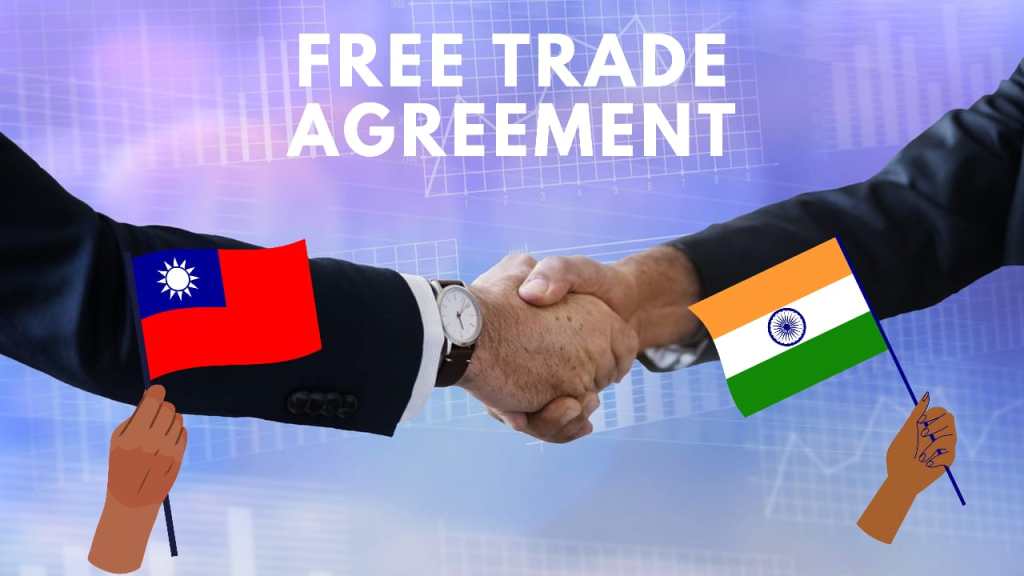
In September and October 2025, Taiwanese authorities and business leaders made public appeals to fast-track negotiations for a Free Trade Agreement (FTA) with India. James Chih-Fang Huang, chairman of the Taiwan External Trade Development Council (TAITRA), speaking at the Taiwan Expo 2025 in New Delhi, called on both governments to act swiftly, stating, “An FTA will certainly facilitate business cooperation. Taiwanese companies are very interested in developing partnerships with Indian companies”.
Yu-Chi Chen, Executive Director of the Economic Division, Taipei Economic and Cultural Centre, highlighted historic growth, forecasting that bilateral trade is likely to surpass $11 billion in 2025, driven by resilient demand and expanding electronics manufacturing.
Taiwanese economists, such as Kristy Hsu of the Taiwan-ASEAN Studies Center, expressed willingness to reduce tariffs on Indian agricultural imports to strengthen ties. Parallel to these diplomatic statements, high-level working groups and industry round tables including the Taiwan-India CEO Round table and Business Councils have been convened to build consensus for an FTA and reinforce economic dialogue.
Strategic and Economic Implications
A prospective FTA could transform bilateral trade architecture, removing tariff barriers, promoting investment, and accelerating technology transfers. Key anticipated benefits include:
Supply chain diversification: Taiwan’s expertise in electronics and India’s growing market could foster resilient supply chains, reducing dependence on China for critical components.
Semiconductor ecosystem: Joint ventures like the Tata-PSMC semiconductor fab in Gujarat could receive a significant boost, positioning India as a credible global electronics hub and supporting its “Make in India” initiative.
Investment and job creation: Investors like Delta Electronics and Foxconn have announced major expansions, contingent on policy stability and improved business conditions in India.
Market access: Eased trade barriers would enable Indian firms to tap into Taiwan’s advanced technology sector, while Taiwanese exporters would gain wider entry into the Indian consumer market.
Geopolitical Context
In the wider Indo-Pacific, this diplomatic overture occurs amid growing concerns over supply chain security, strategic competition with China, and the recalibration of regional economic linkages. India’s pursuit of closer ties with Taiwan aligns with efforts to hedge against Chinese economic coercion and to play a greater role in Indo-Pacific frameworks such as the Quad.
However, the FTA bid has geostrategic sensitivities: strengthening India-Taiwan ties could invite diplomatic friction with Beijing, given China’s firm stance on the One-China policy. New Delhi must balance these interests against the risks of antagonizing Beijing, which has a history of objecting to official interactions between Taiwan and other countries.
Expert and Policy Opinions
Experts largely view the potential FTA as a win-win, albeit with clear diplomatic caveats. Economist Kristy Hsu argues that India should streamline labor laws and work visas to capitalize on Taiwanese investment. Policy analysts from Indian think tanks highlight the initiative as a pragmatic move to leverage supply chain relocation and technology transfer as part of global “China+1” strategies.
International relations scholars caution that India must carefully calibrate its engagement to avoid overt political irredentism, focusing on economic pragmatism rather than formal recognition.
Official Reactions
Taiwanese officials have expressed optimism about the FTA, emphasizing India’s potential as a key trading and investment partner. The Indian government’s stance remains cautious but open reinforcing economic engagement while affirming the One-China principle.
No formal FTA negotiations have been confirmed by India’s Ministry of External Affairs, but ongoing high-level dialogues, joint business councils, and technology partnerships reflect mutual interest in moving forward.
Future Prospects
Though momentum is building, several obstacles remain. India’s broader FTA policy is undergoing review, and negotiations are intricate given its multi-layered trade regime and sensitivities to Chinese reaction. Experts note that sectors such as agriculture, labor mobility, data protection, and standards harmonization could be contentious points in the negotiation process.
Nevertheless, the outlook for an FTA remains positive due to robust private sector advocacy, growing trade volumes, and strong complementarities in electronics, semiconductors, and renewable energy technologies. As New Delhi seeks to become a global manufacturing powerhouse and Taipei looks to diversify beyond China, a comprehensive FTA could be on the horizon reshaping regional value chains and the Indo-Pacific economic landscape.
References
Suneja, K. (2025, October 15). India, Taiwan urge WTO to delay ICT duties ruling as talks continue. The Economic Times. Retrieved from https://economictimes.indiatimes.com/news/economy/foreign-trade/india-taiwan-request-wto-to-defer-ict-import-duty-dispute-ruling-until-apr-2026/articleshow/124555097.cms
Verma, P. (2025, October 7). Taiwan wants FTA with India, will reduce tariffs on Indian farms products, says Taiwanese economist. Moneycontrol. Retrieved from https://www.moneycontrol.com/news/business/taiwan-wants-an-fta-with-india-will-reduce-tariffs-on-indian-farms-products-says-taiwanese-economist-13600966.html
Huang, J. C.-F. (2025, September 26). Hoping for India-Taiwan FTA; will encourage more Taiwanese firms to India: Chairman of Taiwan External Trade Development Council. The Sunday Guardian. Retrieved from https://sundayguardianlive.com/world/hoping-for-india-taiwan-fta-will-encourage-more-taiwanese-firms-to-india-chairman-of-taiwan-external-trade-development-council20250926105644-150021/
Invest India. Growing economic synergy between India and Taiwan. Retrieved from https://www.investindia.gov.in/team-india-blogs/growing-economic-synergy-between-india-and-taiwan
Eurasia Review. (2025, October 8). Taiwan wants a FTA with India [Op-Ed]. Eurasia Review. Retrieved from https://www.eurasiareview.com/08102025-taiwan-wants-a-fta-with-india-oped/
Republic of China (Taiwan). ROC Taiwan. Retrieved from https://www.roc-taiwan.org/in_en/post/39.html
Dwivedi, S. (2025, August 22). Why India’s semiconductor mission needs Taiwan. Swarajya. Retrieved from https://swarajyamag.com/economy/why-indias-semiconductor-mission-needs-taiwan
Rao, A. (2025, August 21). India’s Free Trade Agreements: Updates in 2025. India Briefing. Retrieved from https://www.india-briefing.com/news/indias-free-trade-agreements-updates-2025-36271.html/
Cyrill, M., & Kapur, Y. (2025, August 25). Setting up a semiconductor fabrication plant in India: What foreign investors should know. India Briefing. Retrieved from https://www.india-briefing.com/news/setting-up-a-semiconductor-fabrication-plant-in-india-what-foreign-investors-should-know-22009.html/
Verma, A. (2025, October 10). India and Taiwan: Strengthening bonds through semiconductors, science, shared values. ETGovernment. Retrieved from https://government.economictimes.indiatimes.com/news/digital-india/india-and-taiwan-strengthening-bonds-through-semiconductors-science-shared-values/124422353

Aditya Shrivastav, is a Writing Associate with The Indo-Pacific Politics. He’s currently a student of B. Tech. Computer Science student at Ajeenkya D. Y. Patil University , Pune.
Views expressed in this article are of the author and do not necessarily reflect the views of the publication, The Indo-Pacific Politics.

 क्षेत्रीय संवाद (Platform for Regional Discourse ) 區域對話的平台