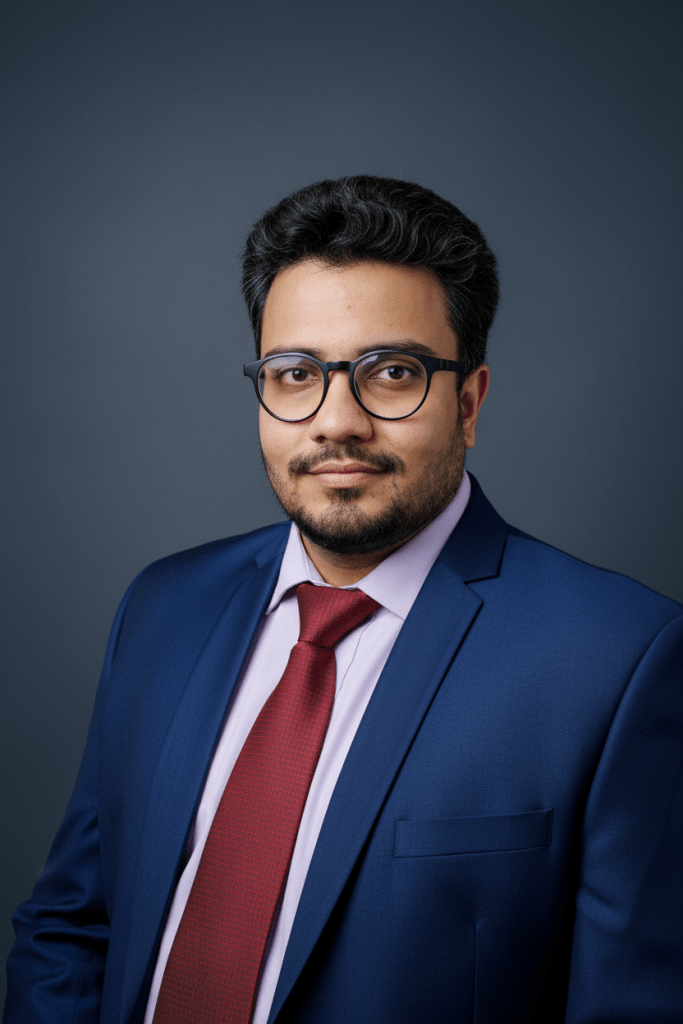
Manik Kumar is currently based in Hsinchu, Taiwan and is working as the Vice President – India Operations at Hua E Precision Ltd (Group). He’s also serving as the Associate Director for the ELCINA Taiwan Desk, the liaison office established by the Electronic Industries Association of India (ELCINA) to build closer partnerships between the Semiconductor / electronics industries of India and Taiwan. He has previously worked with leading Taiwanese technology companies, including the Foxconn Group’s Socle Technology Corp, Macronix MXIC International, and Neotec Semiconductor, mainly in semiconductor design, sales, marketing, and business development roles.
Manik Kumar first came to Taiwan in the year 2008 as a student of BBA in Management, and later completed his MBA in Technology Management from National Yang Ming Chiao Tung University in 2013. Over the past 17 years, Taiwan has become his second home, initially supported by a full scholarship from the Ministry of Education. His learning of Mandarin Chinese opened many doors for his career and network.
He’s is currently focusing on investment promotions, semiconductor supply chain migration, and overall strengthening business ties between India and Taiwan. The Indo-Pacific Politics interviewed him about India-Taiwan ties, particularly the bilateral collaboration on semiconductors. His viewpoints about why India-Taiwan trade ties are more than trade and are a means to build openness and strengthen democratic values in the region are particularly noteworthy.
“The partnership between India and Taiwan in the semiconductor sector has become one of the most exciting stories in global technology today.”
Manik Kumar, Associate Director, ELCINA Taiwan Desk
The Indo-Pacific Politics: What’s special about India-Taiwan semiconductor ties in the next five years?
Manik Kumar: The partnership between India and Taiwan in the semiconductor sector has become one of the most exciting stories in global technology today. In the next five years, this relationship will likely stand out not only for boosting supply chains and innovation but also for bringing both countries into the spotlight as key drivers of the semiconductor industry especially for OSAT, Fabless design and manufacturing related opportunities.
India offers a large market, a talent pool, and a rapidly expanding electronics ecosystem, while Taiwan brings unmatched semiconductor know-how from design to production and manufacturing depth. Together, the two countries can build a more stable and diversified global supply chain over the next five years and become world suppliers – one that benefits both nations and the world. What truly sets this partnership apart isn’t just its business value or technological advantage—it’s the shared trust, values, and ambitions that both countries bring to the table.
“India offers a large market, a talent pool, and a rapidly expanding electronics ecosystem, while Taiwan brings unmatched semiconductor know-how from design to production and manufacturing depth.”
Manik Kumar, Associate Director, ELCINA Taiwan Desk
The Indo-Pacific Politics: In India’s overall grand plan for building its semiconductor industry, how is India seeing Taiwan in 2025?
Manik Kumar: India and Taiwan aren’t just working together for short-term gains. They’ve moved into a stage of deep, meaningful collaboration that looks beyond transactions. India brings its large and growing market, a diverse pool of talented engineers, and a fast-growing electronics ecosystem. Taiwan, on the other hand, is unmatched in chip design, manufacturing, and foundry expertise.
By joining forces, both sides are creating a global supply chain that’s more flexible and less vulnerable to disruptions. In the coming years, this partnership aims to help both countries become world-class suppliers—lifting their economies and shaping the future of technology worldwide.
The Indo-Pacific Politics: What’s Taiwan’s interest in investing in India’s semiconductor industry?
Manik Kumar: India’s vision for its semiconductor industry through 2025 and beyond is clear: make Taiwan a true, long-term partner, not just a supplier. Taiwan is valued for its manufacturing know-how, chip design expertise, and training specialized talent. The idea is to build up India’s homegrown semiconductor capabilities, and Taiwan plays a vital part—offering technology, best practices, and support. What unites the two is a foundation of respect and a shared commitment to technological growth.
“The Indian government is rolling out generous incentives and clear policies, and the market itself is massive and expanding.”
Manik Kumar, Associate Director, ELCINA Taiwan Desk
The Indo-Pacific Politics: SEMICON 2025, the annual activity for the global semiconductor industry organized by SEMI (Semiconductor Equipment and Materials International) was held at the Taipei Nangang Exhibition Center from Sep. 10 to Sep. 12 and witnessed enthusiastic participation by India. How do you analyse India’s participation in it?
Manik Kumar: Taiwanese companies see India as more than just a growth market—they see a place to co-innovate and grow stronger together. The Indian government is rolling out generous incentives and clear policies, and the market itself is massive and expanding.
For Taiwan, teaming up with India means access to new opportunities and the chance to strengthen global supply chains, fueling long-term progress for both countries.
The Indo-Pacific Politics: At the Taiwan Expo 2025 in New Delhi from Sep. 25 to Sep. 27, Keven Cheng, Deputy Director of the Taiwan External Trade Development Council (TAITRA) said that Taiwan needs rare earths from India for its high-tech industry. How do you judge Taiwan’s offer for chips in return for India’s rare earths?
Manik Kumar: India’s participation at SEMICON Taipei—a leading event for the semiconductor industry—has grown more significant each year. Indian representatives are coming to the table with concrete plans and a proactive approach, making it clear to the world that India is committed to becoming a global semiconductor powerhouse and is ready to collaborate at the highest level.
The Indo-Pacific Politics: What kind of contributions are made by Indian tech engineers in Taiwan? Are there any notable examples?
Manik Kumar: Indian engineers are making their mark across Taiwan’s tech landscape, from software and chip design to hardware testing and AI acceleration. Their contributions have quietly powered some of the industry’s most significant advances, including at top companies such as TSMC, Foxconn, MediaTek, and PSMC. Their expertise reflects the real, everyday strength of the partnership.
The Indo-Pacific Politics: Is there anything else that you want to share on this topic?
Manik Kumar: What’s remarkable about the India–Taiwan semiconductor partnership is that it’s about much more than commerce—it’s a story of shared democratic ideals, openness, and a drive to innovate together. As India looks ahead to 2025 and 2030, Taiwan will remain central to its journey in high-precision manufacturing, chip design, and the development of new generations of talent. If both countries stick to this path—working together with respect, transparency, and technical know-how—their collaboration can set new standards for technology leadership not just in Asia, but around the globe.
In Summary: Ultimately, the India–Taiwan semiconductor relationship is a partnership shaped by trust, shared goals, and mutual progress. Working together sincerely and with technical expertise, the two nations are poised not only to transform industries but also to inspire others with what’s possible when global partners collaborate for the greater good.
 क्षेत्रीय संवाद (Platform for Regional Discourse ) 區域對話的平台