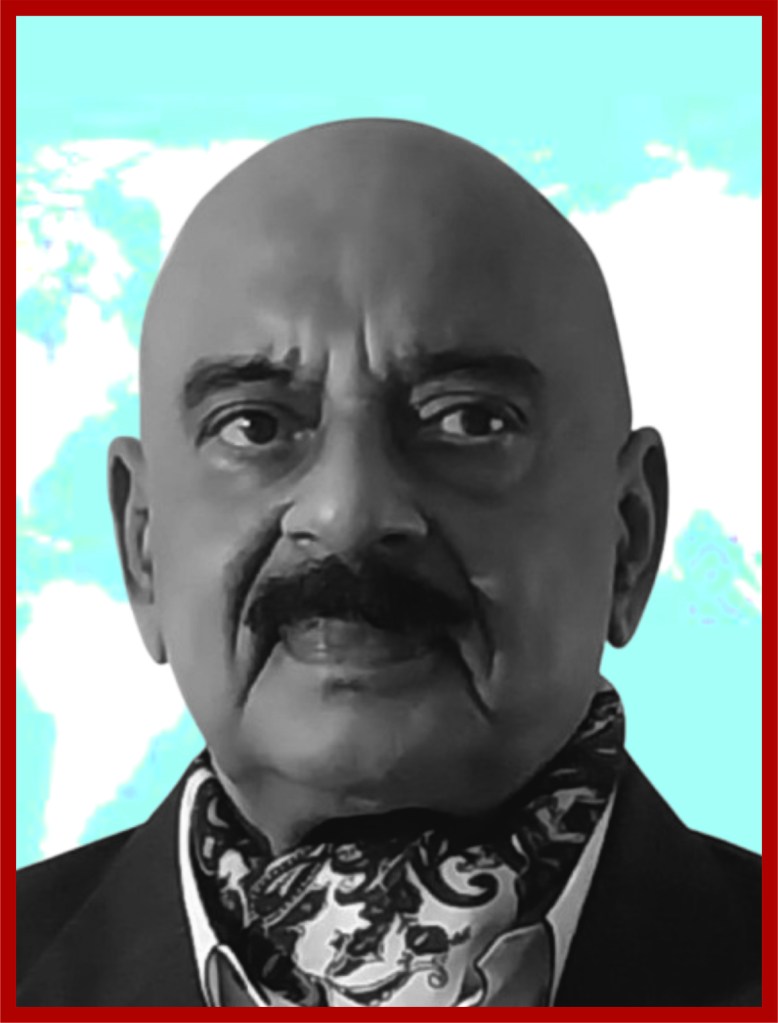
SD Pradhan has earlier served as the chairman of India’s Joint Intelligence Committee. He has also been the country’s deputy national security adviser. He was chairman of the Task Force on Intelligence Mechanism (2008-2010), which was constituted to review the functioning of India’s intelligence agencies. He has taught at the departments of defense studies and history at the Punjabi University, Patiala. He was also a visiting professor at the University of Illinois, US, in the department of arms control and disarmament studies.
Mr. Pradhan regularly authors a column at the Times of India titled “The Chankya Code” and has a close eye over the affairs in the Indo-Pacific region. The Indo-Pacific Politics talked to him about the India-Taiwan ties and how they are different from earlier years and why are they important for the future. This interview was originally taken on March 1, 2025 and has been updated with fresh comments from the expert this month.
The interview presents his viewpoints about India-Taiwan ties on a wholesome paradigm consisting of three pillars, “Development, Economy, Culture.” This paradigm and what would be India’s response if China attacks Taiwan are particularly noteworthy in this conversation.
“We all are worried about Chinese encroachment, Chinese aggressiveness, and they all want that this Chinese aggressiveness should come to an end. This is a common issue for all the QUAD members and smaller power states.”
S.D. Pradhan, Former Indian Dpty. NSA
The Indo-Pacific Politics: What are the most important aspects of India-Taiwan relations today?
S D Pradhan: Basically our relationship has three dimensions. First is development, second is economy and third is culture. You see this is the oldest part of China, the real China with which we [India] had a civilization link. After the PRC occupied the mainland, our relationship with Taiwan was not there at all. It began only in 1991 when we liberalized our system and we realized that for culture and economy it’s important to re-look at our policy. Then we started looking at it and in 1995 we established representative offices. So it was very late that we started to establish our cultural and economic centers and it was only in 2006 that the trade was $2 billion and it’s almost 4.5 times of that now. So it has increased.
Actually our relationship increased with Taiwan while China was trying to occupy this island. Because we realized that it is very important we started establishing a relationship. If you recall, recently [since 2011], we stopped talking about one China policy in our official documents. Our two MPs attended the Presidential oath-taking ceremony of the former Taiwanese President, Tsai Ing-wen in 2020. And then we also increased our relations [further] with them. Several agreements had been signed, including in agriculture, allowing custom duties to go down, and because we were interested in the electronic items produced by Taiwan we have almost made 10 agreements with them till now.
We have a labor agreement also, but it is not working very well. But what is very important, therefore, is the Indo-Pacific strategy and Taiwan remains one of the important entities. There is an agreement between all the members that it remains an important entity for Our Indo-Pacific strategies, for the free and open Indo-Pacific oceans initiative of the QUAD members.
We all are worried about Chinese encroachment, Chinese aggressiveness, and they all want that this Chinese aggressiveness should come to an end. This is a common issue for all the QUAD members and smaller power states. Actually the strategic community thinks that if Taiwan is occupied by China, it’ll cause more tension in the region because Chinese appetite would be vented and it’ll start attacking other smaller countries. The Indian strategic community thinks that Taiwan should remain as it’s. Though we don’t openly say that one China policy has been changed, we are trying to develop broader relations with Taiwan.
The problem is there are several challenges-one challenge is off-course China itself–it keeps on telling that don’t go very close to Taiwan. You will recall that in 2020, they advised our journalists not to give any credit to that incident. But the Taiwan government is very important for China’s history because when the revolution took place in 1911, it was the Nationalist government (Taiwan) that replaced the Manchu dynasty. Subsequently, China was divided into two after the civil war.
Now India has taken interest in semiconductors and Tata and TSMC had [earlier] come together but then there are problems in the sense that they require labor but they are not satisfied with our labor. Taiwanese companies aren’t accepting–that’s one challenge. There’s a potential of $10 billion in semiconductors and moving ahead Modi is taking a lot of interest in it and I hope in the coming years we’ll be able to establish a chain of manufacturing away from China. And you can see that our east policy and China’s south-bound policy both have similar dimensions. For Taiwan, India is a focal point of a new outgoing policy, trying to expand into other areas away from China. Our own policy is also giving preference to electronics, semiconductors and ICT products Taiwan can produce, but we have to meet the challenges quietly. While we may not officially say that the ‘one China policy’ has been discarded, by action we can keep our links with Taiwan, which is necessary for our development and for the larger success of the objective of the Indo-Pacific strategy.
“Indian Strategic Community thinks that if Taiwan is annexed, then we’ll face more problems. So Taiwan’s status must be preserved.”
S.D. Pradhan, Former Indian Dpty. NSA
The Indo-Pacific Politics: You mentioned three aspects of India-Taiwan relations. You also mentioned concerns of the Indian strategic community. Are there strategic contexts to India-Taiwan ties?
S D Pradhan: Indian Strategic Community thinks that if Taiwan is annexed, then we’ll face more problems. So Taiwan’s status must be preserved. Thus that is one important thing, and for this, Australia, Japan, South Korea–Of course, South Korea is not a member of QUAD but we are dealing with South Korea as well, and they all feel that Taiwan’s status should be maintained. It should not be annexed by China. But the geo-political, strategic landscape is changing because the Chinese are crossing over into Taiwanese areas, Taiwanese waters, and flying over Taiwanese sky. That has to come down!
Now we have to also see–you know there is a view that the US, under Trump, has adopted an isolationist policy and mayn’t be very keen to get involved in the Taiwan issue. The Indian strategic community thinks that if “Making America Great Again” means that it must be able to influence international development, he cannot withdraw from South China Sea or Indo-Pacific regions.
The Indo-Pacific Politics: India has entered semiconductor partnerships with other big global corporations like with UK-based, semiconductor giant, ARM to design advanced 2-nanometer chips. Currently India has two semiconductor partnerships with Taiwan–TATA PSMC and Micron’s ATMP facility while this year Taiwanese firms like Foxconn, Pegatron decided to expand their presence, alongside new deals like Cyient Semiconductors and Navitas focusing on Gallium Nitride (GaN) tech, all driven by Indian government incentives and Taiwan’s chip expertise to build a robust local supply chain.
However TSMC has decided to not invest in Taiwan. How’s India’s semiconductor partnership with Taiwan different from its partnerships with other global giants?
S D Pradhan: The goal of India’s Semiconductor Mission (ISM) is to set up wafer fabrication (fabs), display fabs, packaging/assembly/testing units (ATMP/OSAT), and boost chip design and R&D within India. It backs a “Design-Linked Incentive (DLI)” scheme: startups and MSMEs working on chip/IC design get support for design infrastructure, reimbursement on design expenses, and deployment-linked incentives based on sales. Currently, India has 10 approved semiconductor-related projects across multiple states, with cumulative planned investments totalling around ₹1.60 lakh crore. In May 2025, the government inaugurated two chip-design centres (including work on very advanced 3-nanometer chip design) in Noida and Bengaluru. India is now focusing on 2 nm chip technology. Reports suggest that India has already produced 2nm chips. This represents a decisive step in technological self-reliance. The shift in strategy reflects a move beyond earlier phases (basic electronics/assembly) toward more robust chip manufacturing, packaging, and design.
The official policy envisions India becoming a significant global player in semiconductors. Some Taiwan companies have invested in India (about US $5 billion in Indian manufacturing). You have rightly mentioned that two Taiwanese companies have links with India. Powerchip Semiconductor Manufacturing Corporation (PSMC, Taiwan) is partnering with the Indian conglomerate Tata Electronics to build a large semiconductor fabrication plant at Dholera, Gujarat. Foxconn Technology Group – a major Taiwanese electronics‐contract-manufacturer – is involved via a joint venture with Indian firm HCL Group to set up a semiconductor/OSAT facility near Jewar, Uttar Pradesh. There is a new commitment from a Taiwanese group to build an “India–Taiwan Industrial Technology Innovation Park (ITIP)” in Karnataka (≈ ₹1,000 crore) focused on electronics and semiconductors, as part of expanding chip-manufacturing infrastructure. But not all top Taiwanese chip-makers are joining India yet. For instance, some of the most advanced global Taiwanese firms/manufacturers have reportedly been cautious or declined to commit to Indian fabs.
“While India does not have formal diplomatic relations with Taiwan, economic-commercial cooperation is still moving forward strongly. This indicates that business imperatives – global supply-chain realignment, chip demand growth – can transcend political constraints in the coming period.”
S.D. Pradhan, Former Indian Dpty. NSA
India’s partnership with Taiwan is different in several aspects. First there is complementarity that creates synergy. While Taiwan brings hardware-manufacturing expertise, especially in chip fabrication, packaging and global supply-chain know-how, India offers a large and growing domestic market, cost-competitive labour, and increasing design and engineering talent. Second, now as India has decided to provide generous support under ISM (heavy fiscal incentives, subsidies, support for design and packaging, and push to build a domestic ecosystem), Taiwan-based firms find a favourable environment compared to the earlier period. Third, as the global firms are shifting supply chains beyond China in response to rising geopolitical uncertainties, India offers a stable, large-market alternative for manufacturing for the Taiwanese firms. India is part of that “China-plus-one / diversification” trend.
Fourth, India is pushing a holistic system, not only an assembly of chips. The current push (supported by ISM + Taiwanese cooperation) aims at wafer fab setup, chip testing/packaging, advanced packaging and even design. This makes the partnership more meaningful and future-oriented. Fifth, while India does not have formal diplomatic relations with Taiwan, economic-commercial cooperation is still moving forward strongly. This indicates that business imperatives – global supply-chain realignment, chip demand growth – can transcend political constraints in the coming period. At the political and strategic levels, there is mutual appreciation and a desire to build closer ties. In essence, the partnership leverages India’s demand, market size, human resources and government push, plus Taiwan’s semiconductor manufacturing strength, creating a constructive and pragmatic alliance in tech and supply-chain diversification. In my opinion, this partnership has a bright future.
The Indo-Pacific Politics: If there is an invasion of Taiwan by China what do you think would be India’s stand?
S D Pradhan: Very difficult thing to answer, because India doesn’t want war. But when the situation arises, then you have to take a hard decision, and I think along with other countries, there will be involvement to check it, because QUAD [alliance between the US, India, Japan and Australia] is not a military alliance, but when the situation demands that one particular nation is subjected to coercion beyond a point then others will come to the rescue. I have a faith in this country that it will put their might to ensure that Taiwan doesn’t loose its independence.
 क्षेत्रीय संवाद (Platform for Regional Discourse ) 區域對話的平台