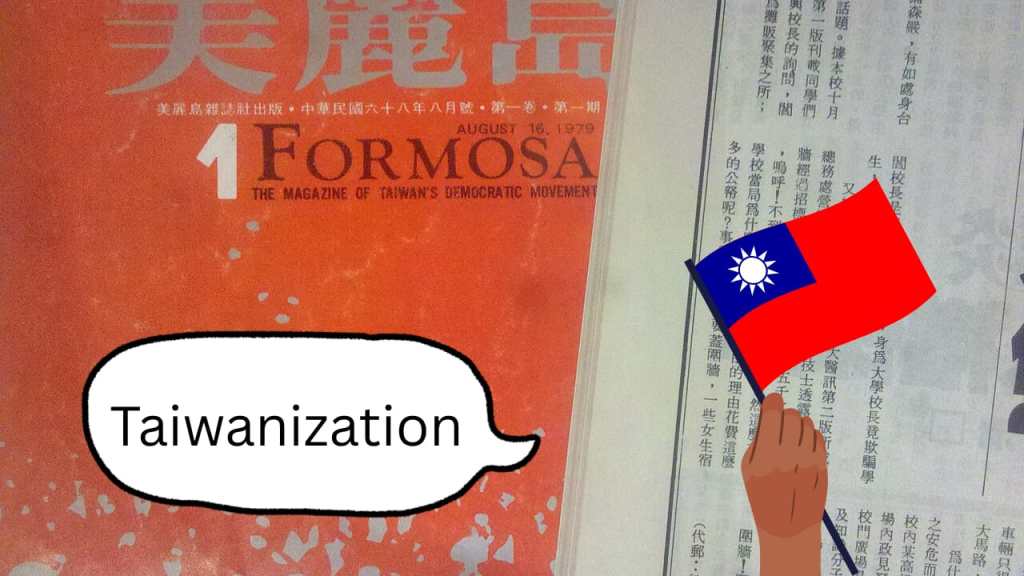
Mr. Liu, is a senior Taipei based political analyst who has firsthand witnessed Taiwan’s political landscape including its Democracy movement and the subsequent evolution of Taiwan’s political parties. He has years of experience and associations with elite institutions and sources in Taiwan. Venus Upadhayaya, the Editor of Indo-Pacific Politics met Mr. Liu (identity concealed on request) multiple times in Taipei during her 2025 MOFA fellowship period to gather his viewpoints and rich existential understanding of the world inside and outside of Taiwan.
Mr. Liu gives a very detailed and anecdotal narrative of what was Taiwan before it was handed over to the Kuomintang (KMT) Nationalist government, led by Chiang Kai-shek; What kind of demographic changes transpired in Taiwan after the exodus of one million from the mainland to Taiwan during that year; How KMT’s fantasy of recovering China turned catastrophic for the people of Taiwan as policy making and governance got constricted under dictatorship; How and why democracy linked political activism shaped in Taiwan; How the Wild Lily Movement, the Sunflower movement and the Dangwai Movement finally shaped Taiwan’s current political functioning and identity.
For the sake of readability, this interview is divided into two parts. The first part is a detailed discussion about why Chiang Kai-shek refused to modify ROC constitution, how policy making and legislative MPs became impractical institutions in the martial law period, how constitutional reform was achieved and what’s meant by Taiwanization and Democratisation in this context.
Part 1: Taiwanization: History & the Present of Taiwan’s Democracy With Senior Taiwanese Analyst published on March 30, 2025.
Part 2: Taiwanization: History & the Present of Taiwan’s Democracy With Senior Taiwanese Analyst will be published on April 1, 2025.
The Indo-Pacific Politics: Taiwan has a complex history. Why is this history relevant to its identity today?
Mr. Liu: To understand Taiwan’s identity it’s important to understand Taiwan’s history–more so the history of KMT’s arrival in Taiwan and how it shaped the demography, society and the public sentiment in the island that Japanese handed over to the ROC [Republic of China] in late 1945.
Let’s start with understanding the demography of ROC in 1948, a year before KMT retreated and landed in Taiwan. The population of ROC was 460 million. The population of Taiwan was 6.8 million. So that’s 1.5 percent of the ROC and in that year 48 percent pass the [civil service] exam ((科舉, kējǔ). The quota for Taiwan was 8, so that was for 1.5 percent of the population. And in 1949 almost one million people migrated from mainland China to Taiwan. I told you, before 1948 the population was 6.8 million, so 6.8 million plus one million, it became almost eight million–because of armies and civil servants from mainland.
And gradually the population of Taiwan increased, so supposedly they should have increased the number of civil servants from Taiwan but they didn’t do that. They said we are going to go back to mainland China, so we shouldn’t change the system. They also said they can’t do the population census. Every ten years there’s a census but they didn’t do the census, even in mainland China it remained the same–1950, 1960, 1970–I think in 1970 there was pressure on KMT because all the [ROC] MPs who moved with them from China to Taiwan gradually passed away. But then they said we don’t know the population change in mainland China but we know that the Taiwan population has changed, so Taiwan area should have more seats. So they increased the number of seats [through supplementary elections] from 759 to additional 51 in 1972 and additional 52 in 1975. [The 759 arrived from mainland and remained in their seats indefinitely]. With this they also changed the civil service seat quota for Taiwan province.
How much did it change? In 1987, two years before the martial law was lifted the population of whole of Taiwan was 23.6 million. Remember it was 8 million in 1950 including 13 percent of those who arrived from mainland and 87 percent of the native Taiwanese! But what was the quota in the civil service exam for Taiwan province–it increased from 8 in 1948 to 22 in 1989. The total number of civil servants for the whole of ROC was 600, so 22 divided by 600 is 3.7 percent. This means 87 percent of the native Taiwanese population was allowed to hold only 3.7 percent of the civil servant offices.
The Indo-Pacific Politics: So what I’m understanding is China didn’t do its census but Taiwan did it in 1970s. So even if China’s population changed, they didn’t show it in policy making. May be they politically, deliberately did that! May be they killed a lot of people.
Mr. Liu: Yeah! And it becomes even more ridiculous further–in 1989, 23 million was the population of Taiwan. How many were there from Tibet and Mongolia? You guess! It was probably 100. How much was the quota assigned for these populations in the whole of ROC demography [defined by KMT, for the ROC it recognised including the mainland]? It was 22 for Taiwan, 8 for Mongolia and five for Tibet. This was out of proportion.
The Indo-Pacific Politics: Today there are 200 Tibetans in Taiwan. That also means that Tibet and Mongolia were recognised as part of the ROC. How’s it today?
Mr. Liu: Right, at that time! Yeah!
Today Mongolia is excluded but Tibet’s [status] isn’t clear. Tibet, according to the old KMT is still part of the ROC because Tibet is also included in PRC but Mongolia was excluded already.
The Indo-Pacific Politics: Tell me one thing. Mao annexed Tibet in 1950-51 and KMT left mainland before that. So are you saying that when KMT was in power in mainland it had designs to annex Tibet?
Mr. Liu: Well! you know there are many ministries–Defense ministry, ministry of education, ministry of finance and we had a committee for Mongolia and Tibet in the Central government at that time. See, they managed all things related to Mongolia and Tibet. This special committee in the central government is in the cabinet, actually led by a cabinet member and it remained even after Chen Shui-bian was elected president and DPP was in power. Why? Because that was written in the ROC Constitution, you cannot remove that. This confusion came from mainland China with the KMT.
The Indo-Pacific Politics: This is where I’m very confused. I’m not able to understand if today the constitution of Taiwan is the constitution that came with KMT from mainland China or have you modified it?
Mr. Liu: Actually it has been modified a little bit. We have this special committee on Mongolia and Tibet and the head of that, who is also a Cabinet member, in the year 2002-2004 he was a friend of mine, and he had nothing to do because he was in charge of the all matters related to Mongolia and Tibet. But actually it’s not under the ruling of Taiwan or Republic of China in Taiwan. So there’s really nothing much to do.
The Indo-Pacific Politics: So you are saying like in the martial law period the MPs in Taiwan were elected for whole of China but practically they could never go to China, and they could never do anything, and they were not ruling also. They could not even help people or meet people. Similarly, this committee on Mongolia and Tibet, they are sitting in Taiwan, but they could actually not go to Mongolia or not go to Tibet.
Mr. Liu: All they can do is, they have this scholarship for Tibet–Tibetan people living in India can apply for the scholarship. To study in Taiwan some people can do that but I know that Tibetan people in India don’t necessarily think they are part of the ROC but still some people can get the money to study.
The Indo-Pacific Politics: So are you saying that the 100,000 refugees who came to India along with the Dalai Lama are a part of the ROC?
Mr. Liu: I always think that but they don’t think that way. Just enjoy yourself. [Collective loud laughter]. It’s very ridiculous! So I was joking with my friend who was the head of the Committee for Tibet and Mangolia that you can’t travel to tibet but you can travel to India and use the government money because you want to see your people.
The Indo-Pacific Politics: But then the Dalai Lama has created a Tibetan Government in Exile, also called the Central Tibetan Administration (CTA) with its headquarters in Dharamshala, India.
Mr. Liu: Yeah, I know that! Anyway I should add that before 1949 in mainland China, Tibet and Mongolia weren’t two provinces. There was a special status for them, so that’s why they had to create a Cabinet position called the Committee for Mongolia and Tibet. They aren’t a part of the Ministry of Internal Matters.
So we really want to remove this ridiculous thing because it has really become impractical, like living in fantasy. For example you can’t even have a normal distribution of the civil servants. So if today we have 200 Tibetans and Mongolian living in Taiwan, at that time we had only 100 and they had assigned five civil servants for them. That means I can face the exam with no effort. That’s really ridiculous!
The Indo-Pacific Politics: So it was basically to maintain the authoritarian rule, right?
Mr. Liu: Yeah!
The Indo-Pacific Politics: If people don’t believe that they’re going to one day go back to China and rule over China, then why would people accept them as their ruler! That’s the thing! Because he [Chiang Kai-shek] got all the people from there [mainland china] with this only one promise that we’re going to go back.
Mr. Liu: So the constitution of ROC was written in 1947, two years before they fled to Taiwan and Chiang Kai-shek said that this is the constitution for ROC-China. One day we’ll go back to mainland China and we’ll bring back the constitution intact. No change! There was also a practical reason for that because if they would have changed the population [through regular census] all the civil government [departments] 87 percent would be filled with Taiwanese people.
This is because before 1980, 87 percent of the population was native Taiwanese meaning the non-mainland population that existed before KMT moved to Taiwan. So if they would have changed the civil servant examination population to 87 percent straight, only 13 percent would be left for mainland Chinese people on the island. The whole government would have become of the Taiwanese!
But they did increase a small percentage for example they increased the number of MPs otherwise they would not have enough MPs. So they decided to modify the constitution a little bit like certain articles in the constitution were temporarily suspended. For example they decided how many MPs should be there in the Congress. Otherwise it wouldn’t function because many MPs [who came with Chiang Kai-shek] died.
In 1991 when Chiang Ching-kuo died and Lee Teng-hui became the President [of Taiwan], they didn’t want him to become the Chairperson of the KMT. But it didn’t go that way because Lee Teng-hui got the support of some younger MPs. So he became not only the President of Taiwan but also the party chairperson. Before that for 2-3 years he was the Vice-President. When he was elected as the President, the election wasn’t very popular because only a small number of people, roughly about 2000 were allowed to vote. That also came from the same population of 13 percent.
The Indo-Pacific Politics: So it means that these 13 percent of the people were ruling over whole of Taiwan and they were also the puppet rulers of the whole of China.
Mr. Liu: I won’t say like that!
The Indo-Pacific Politics: They were puppet rulers because they were ROC’s legislative MPs with mandate over whole of mainland China but they could never go to the mainland, to their constituencies.
Mr. Liu: Right! Right! Right! So President Lee Teng-hui did a great thing in 1991, he tried and succeeded to modify the constitution. He changed the constitution in a way that MPs should be re-elected in Taiwan. Before that all the MPs were elected in mainland China in 1947 and they didn’t enable any elections between 1947 and 1991. So the first tenure of the MPs was long, 30-40 years and the second tenure started in 1991 after a second tenure election that year.
Before that Chiang Kai-shek said that he doesn’t want to modify the constitution but they modified a little bit, in the sense they suspended an article here and there in the constitution because they couldn’t hold elections as mainland China was under the Communist. So when Lee Teng-hui modified the constitution to hold an election for the second tenure MPs, that process was called Taiwanization because your older MP was elected in mainland China but your new MP got elected in Taiwan.
This is the main part of Taiwanization because Taiwan became Taiwan [after this election].
The Indo-Pacific Politics: Yeah! In terms of policy makers and law makers and it came out from the fantasy land to real administration!
Mr. Liu: Right! And that was a big step forward. Together with that Lee Teng-hui achieved two things–one is called Taiwanization, the other thing is called Taiwan democratisation. So further on Taiwan would be a democracy because Taiwanese people elected their MPs and they were no longer elected by someone else while they also came from somewhere else!
So because Lee Teng-hui revised the constitution in 1991, we still call ourselves as the ROC constitution but it should be actually Taiwan constitution. It’s not a new constitution, it’s a modified old constitution but it has several new articles.
This is the first part of the interview “Taiwanization: History & the Present of Taiwan’s Democracy With Senior Taiwanese Analyst”. The second part will be published on April 1, 2025.
 क्षेत्रीय संवाद (Platform for Regional Discourse ) 區域對話的平台