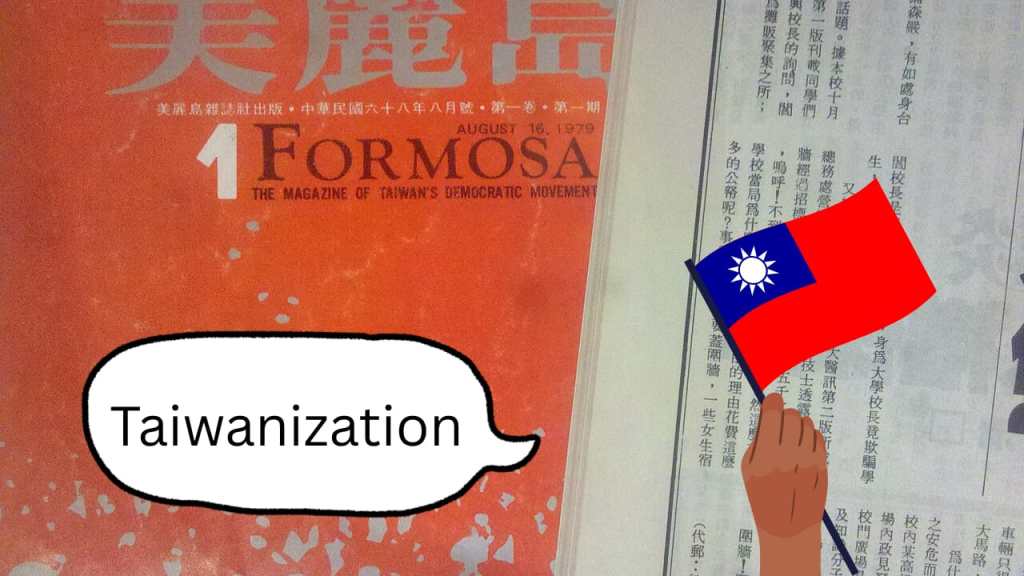
Mr. Liu, is a senior Taipei based political analyst who has firsthand witnessed Taiwan’s political landscape including its Democracy movement and the subsequent evolution of Taiwan’s political parties. He has years of experience and associations with elite institutions and sources in Taiwan. Venus Upadhayaya, the Editor of Indo-Pacific Politics met Mr. Liu (identity concealed on request) multiple times in Taipei during her 2025 MOFA fellowship period to gather his viewpoints and rich existential understanding of the world inside and outside of Taiwan.
Mr. Liu gives a very detailed and anecdotal narrative of what was Taiwan before it was handed over to the Kuomintang (KMT) Nationalist government, led by Chiang Kai-shek; What kind of demographic changes transpired in Taiwan after the exodus of one million from the mainland to Taiwan during that year; How KMT’s fantasy of recovering China turned catastrophic for the people of Taiwan as policy making and governance got constricted under dictatorship; How and why democracy linked political activism shaped in Taiwan; How the Wild Lily Movement, the Sunflower movement and the Dangwai Movement finally shaped Taiwan’s current political functioning and identity.
For the sake of readability, this interview is divided into two parts. This is the second part and it deals with the mention of “unification” and national identity in the Taiwanese constitution, the first national electoral franchise and what shaped the generation that led the Sunflower movement.
Part 3: Taiwanization: History & the Present of Taiwan’s Democracy With Senior Taiwanese Analyst will be published on April 3, 2025.
The Indo-Pacific Politics: Taiwan’s history becomes very complex because ROC’s constitution came to Taiwan along with the KMT and the KMT came to Taiwan after it lost in the civil war to the CCP [Chinese Communist Party].
When you say Lee Teng-hui brought in the 2nd tenure elections with some modifications in the constitution and it should be called the Taiwan constitution, are you saying that ROC, as per the constitutional framework is not there at all?Because ROC was based on an old constitution and ROC practically, in terms of its population, in terms of its land, in terms of its rule of law and rule of the land doesn’t exist. If we say rule of the land, then the land has to be there!
Mr. Liu: Okay! I’ll tell you no because we didn’t go through a revolution. So we didn’t buy new clothes, we had old clothes and we cut here and there–to prevent a revolution–we tried not to create a new constitution. Anyway in 1991 actually it was a big thing, we added some articles to the old constitution and in those articles we say we want to have the elections. This decided how many seats should be there, all should be elected in Taiwan and how many should be in this city and that country etc.
But there’s a preface to these articles which says that before the unification because of practical reasons we should suspend some of the articles in the constitution and we can add some new. “Before the Unification” that’s the key word. And right now, the KMT people say, see, even after the revision of the Constitution in 1991 we are still saying we want to reunify. So that means our country is included in the mainland. So that’s the argument!
But for people on the Taiwanese side, well, that’s meaningless because we are not going to actually compromise. So neither way we can pass the revision of the Constitution at that time because even when the DPP became stronger and stronger but wasn’t in power and the KMT was in power, the old force within the KMT was very strong. So if one wanted to pass any revision to the constitution, one needed their agreement. They probably said Lee Teng-hui was cheating them. We were promised that one day we’ll recover. You know, one day China and Taiwan will unify but before that let’s do this. But once you start it, there’s no return.
The Indo-Pacific Politics: Yeah! that’s very complex! Ok tell me one thing. Does your constitution today believe that one day there’ll be one China?
Mr. Liu: They didn’t say exactly that but there’s a hint because there’s a terminology “before unification of the country.” But what is the country? We din’t say that!
The Indo-Pacific Politics: Oh! So that’s not defined! What’s the country?
Mr. Liu: “Before unification of our country”–I would say yea, we want to unify Taiwan, spread Taiwan. Anyway! But there’s some cheating element there.
The Indo-Pacific Politics: That means your constitution is based on a probability. So what’s if this happens? What if that happens? What if unification happens? If it happens we’ll go this way.
Mr. Liu: Well! At that time we had to satisfy both sides! There’s a possibility [of unification] but I think there’s no possibility of that. Unless there’s some external force. Within Taiwan there’s no possibility!
Coming back to Taiwanization–there was not just political Taiwanization but there’s cultural Taiwanization for example during the KMT period, during the old period, people weren’t allowed to speak Taiwanese. If someone spoke it within the family it was ok but you weren’t allowed to speak it in public [during the martial law period].
The Indo-Pacific Politics: So in a way it was unjust because the language of 13 percent people was spoken while the language of rest of the 87 percent wasn’t allowed.
Mr. Liu: For example my mother was educated in the 1920s-1930s and she couldn’t speak Mandarin but gradually she could understand a few words. But when we were watching TV, during the news time, everything was in Mandarin. So I think she could understand what was going on. Later in 1980s there was a small percentage of Taiwanse news. During the Lee Teng-hui’s time there were a lot of Taiwanse program and Taiwanese had become the mainstream and people could speak Taiwanese everywhere. In 2000-2002 there was a guy who spoke Taiwanese very well, he had a TV program and used Taiwanese language to discuss South Korean affairs. My mother loved him. His name was Wang Ben-hu (汪笨湖).
During that year my mother talked to my sister, almost everyday and I overheard them saying, “Today Wang Ben-hu talked something very interesting. She started to understand what was going on and she started to speak, discuss her opinion on current affairs. You see that was a big change for them because the country became their own country! They were no longer foreigners. That’s another aspect of colonisation.
The third aspect of colonisation education happened after Lee Teng-hui was reelected in 1996 as the President of Taiwan with a popular vote. Why popular vote? Because in 1991, we revised the constitution. So as a result of that the President was voted by the people and not by the second Congress [National Assembly that acted as indirect electoral college].
The Indo-Pacific Politics: What you mean to say is that people got the power of electoral franchise in 1996 before that it was the National Assembly that elected the President [and the Vice President of Taiwan].
Mr. Liu: So that was a big scene. He was really powerful, the real President! So during that year in 1996, there was a trio–Pr, PRC and PLA. PLA that year fired multiple missiles in the waters surrounding Taiwan.
The Indo-Pacific Politics: That means they started to create these threats and this drama around Taiwan during the Presidential elections back then because they did it during your latest Presidential elections as well.
Mr. Liu: But that made Lee Teng-hui the highest leader because people were very angry. So they [PRC] got the opposite results–people weren’t;t threatened but people became very angry.
In 1996, Lee Teng-hui ordered the Department of Education to publish a small book called “Knowing Taiwan.” It was a small booklet and it was for the junior high school. That was the first reading material and they had a class every week. Besides the history class, they had this knowing the Taiwan class. You had this extra class from 1997 to 1999 and interestingly if you look at the History-Geography book of the junior high in 1995, it said that, “Our country is the biggest country in the world–north to the Outer Mongolia, South to the South Sea and West to Xinjiang and East to ….Our country is the biggest country we have 5000 traditions.” So it was a huge country.
I remember when I was in elementary school, it was said our country is the biggest country. But in this book, “Knowing Taiwan” it was said this is our country. So interestingly I still remember it because I did a research on it and it said our country is a small island. It’s surrounded by ocean and because we are surrounded by ocean we had a historic cultural exchange with Europe, America, Japan and everywhere. So that was huge difference in what they started teaching to students. This had a very important impact on the new generation and people because for example the martial law was lifted in 1987 and the child born in that year, entered the elementary school in 1994. He entered the middle school after six years–so junior high in 2000. Their image of our country is completely different from that of their parents. This is the regeneration that participated in the Sunflower movement in 2014. they should be 30-year-old then.
That’s why when we ask: What’s the impact of Taiwanization on the younger population? What do they think about it? They say that we live in it. that’s something very interesting!
Note for readers: During the Sunflower movement from March 14 to April 18, 2014, young political activist occupied the Legislative Yuan (Taiwan’s parliament), the first such event in the country. It was triggered by KMT’s attempt to speedily pass the Cross-Strait Service Trade Agreement (CSSTA) with PRC. It contributed to KMT’s heavy losses in the subsequent elections.
This is the second part of the interview “Taiwanization: History & the Present of Taiwan’s Democracy With Senior Taiwanese Analyst”. The first part was published on March 30, 2025.The Third part will be published on April 3, 2025.
 क्षेत्रीय संवाद (Platform for Regional Discourse ) 區域對話的平台