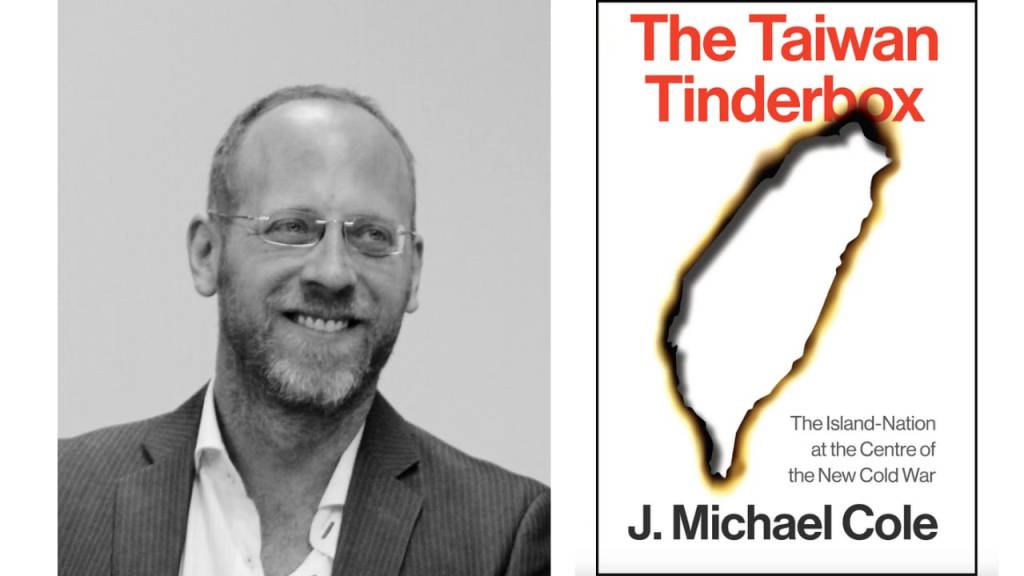
J. Michael Cole (寇謐將) is a Senior Fellow at the Macdonald-Laurier Institute, a Senior Fellow at the Global Taiwan Institute, a Senior Fellow at the University of Nottingham, UK and a Research Fellow at the Prospect Foundation, Taipei, Taiwan. He’s the author of the just released book, The Taiwan Tinderbox.
ASEAN Wonk, a publication with insights on South East Asia and the Indo-Pacific Politics described “The Taiwan Tinderbox” as a book that “widens the aperture on Taiwan well beyond a U.S. response in a military scenario — addressing multidimensional issues ranging from raging cognitive warfare to quiet partner coordination across realms.”
The Indo-Pacific Politics conversed with the Taipei based J. Michael Cole to gather perspectives about Taiwan in the Indo-Pacific, Taiwan-India relations and about his new book, The Taiwan Tiberbox, The Island-Nation at the Centre of the New Cold War published by Polity Press.
“The challenge for Taipei isn’t only that it must reaffirm Taiwan’s importance to the U.S., but must do so while demonstrating a stronger commitment to its own national security while also avoiding the possibility of being dragged into, or become a casualty of, escalating Sino-American tensions.”
J. Michael Cole, Geo-political analyst
The Indo-Pacific Politics: I was going through a 2017 conversation of yours published on China File, ‘US-China Flashpoints in the Age of Trump’. Let’s revisit this during Trump’s second tenure. How do you see Taiwan in the second age of Trump?
J. Michael Cole: Like every other country, and particularly like every other country whose security is deeply tied to the U.S. partnership, Taiwan is learning to navigate the high unpredictability that characterizes the Trump 2.0 administration. Gone are the career officers and foreign policy traditionalists who, for the most part, occupied senior positions in the first Trump administration. President Trump and his top officials appear to have different priorities this time around, with hints of isolationism that are forcing traditional security partners to reassess how best to ensure their national security and, in Taiwan’s case, deterrence against China.
More than ever, relations with the U.S. are transactional, and every country that seeks continued security assurances or guarantees from the U.S. needs to work much more harder to convince the White House — and the MAGA crowd — of its importance to the U.S. The challenge for Taipei isn’t only that it must reaffirm Taiwan’s importance to the U.S., but must do so while demonstrating a stronger commitment to its own national security while also avoiding the possibility of being dragged into, or become a casualty of, escalating Sino-American tensions. Thankfully Taiwan continues to have strong allies in the U.S. government and especially in Congress, but there’s absolutely no doubt in my mind that maintaining that relationship, and keeping the U.S. focused on the Taiwan Strait, is and will be even more challenging than it was when Trump was in the White House the first time around.
Taipei needs the best minds and the best hands on deck, and there is little margin of error; and it must do so at a time when opposition parties in the Legislative Yuan continue to engage in behavior that threatens to debilitate Taiwan’s government institutions and ability to do outreach to foreign partners and allies. In other words, not only has Taiwan’s external environment become more challenging, but domestically the situation is much more unstable than it was during the first Trump administration, when the Tsai Ing-wen administration in Taipei had the advantage of a majority in the legislature.
“I sense fatigue in the American desire to lead the charge in the Indo Pacific — or at least until main allies and partners there have done enough to convince the White House and the American public that they are doing their share, and to help the American public recognize that a free and stable Indo-Pacific is very much in the U.S.’ interest and that retrenchment and isolationism are simply not the solution.”
J. Michael Cole, Geo-political analyst
The Indo-Pacific Politics: You had an article published in GTI in Nov. 2024, ‘Trump Returns to the White House: Implications for Taiwan’ — eight months down the lane much has happened. Trump has almost ushered a global geopolitical shift. Do you see a change in the US administration’s Indo-Pacific Policy? What do you expect for QUAD amidst trade and tariff policies and how do you see this whole situation impacting Taiwan?
J. Michael Cole: As I stated in my response to the first question, the Trump 2.0 administration has given every indication that its priorities may differ from those that we came to recognize during Trump 1.0. I sense fatigue in the American desire to lead the charge in the Indo Pacific — or at least until main allies and partners there have done enough to convince the White House and the American public that they are doing their share, and to help the American public (the MAGA crowd in particular) recognize that a free and stable Indo-Pacific is very much in the U.S.’ interest and that retrenchment and isolationism are simply not the solution. Given the unpredictability of the current Trump administration, it is incumbent upon partners and allies in the Indo-Pacific to intensify their efforts to create a security architecture that on its own is capable of tackling the most pressing security challenges in the region, namely China and North Korea.
The world simply can no longer take U.S. security assistance for granted and therefore groups like then QUAD and other arrangements need to aim for greater coherence, preparedness, and interconnectivity, something more permanent and less divisible than existing entities like ASEAN, which for a number of reasons are unable to act cohesively when it comes to countering Chinese expansionism. For Taiwan, this means finding ways to be included in such initiatives, which perforce will have to be gradual; there, too, Taipei needs to redouble its efforts to convince regional governments and populations that its security, as well as stability in the Taiwan Strait and its environs, is of capital importance to other countries, and to the economic well being of the entire region. Encouragement by the U.S., which wants greater burden-sharing, could also help convince those countries of the virtues of allowing Taiwan to join in some fashion.
The Indo-Pacific Politics: There’s talk about a strategic triangle between Taiwan, Japan and the Philippines. As an Indian I’m very curious about it because India has supplied Brahmos air defense system to the Philippines and we are wondering if this strategic triangle actually has some Indian shades. How do you analyse this?
J. Michael Cole: There are signs of closer security cooperation between those two countries. Given their geographical proximity to Taiwan and ongoing territorial disputes with China, it is only natural that Japan and the Philippines would explore areas of potential cooperation with Taiwan. Due to Taiwan’s idiosyncratic status there are inherent challenges in doing this, but the hard reality of Chinese assertiveness and, as discussed before, doubts over assumptions of continued U.S. security assistance, are compelling decision makers in Tokyo and Manila to reassess their countries’ longstanding Taiwan policy. That includes removing some of the self-imposed limitations on engagement with Taiwan, which the Philippines loosened recently.
Both Japan and the Philippines have no doubt been encouraged by the U.S. to work more closely with Taiwan, and in Japan’s case the need for it to play a more proactive role in regional security means that it will reach out to partners in the region and tighten its cooperation with them. Taiwan’s location in the middle of all this make it to ignore it, especially as its fall to China would represent a huge setback for every country in the region. So what we’re seeing is a natural evolution, and this triad of counties will most assuredly welcome support — military and diplomatic — from other regional powers like India.
“Taiwan is always interested in deepening its relationship with India and understand the important role that India can play in the region.”
J. Michael Cole, Geo-political analyst
The Indo-Pacific Politics: How’s Indian Prime Minister Narendra Modi’s trip to Japan and then to China for the SCO comprehended in policy circles of Taiwan? Is there a shift in the way India interests Taiwan in 2025?
J. Michael Cole: Taiwan is always interested in deepening its relationship with India and understand the important role that India can play in the region. Taipei understands the balancing act that India must perform between the U.S. and China, and therefore plays close attention to trends, to the ups and down in India’s relations with China.
People-to-people exchanges between Taiwan and India have been flourishing, as have opportunities for trade and cooperation in various areas. In the more contentious sphere of security cooperation exchanges have been more careful, and I regard this as part of Taiwan’s gradual approach to such matters, which are based upon the recognition that potential partners have their fears and limitations when it comes to doing so.
However, as with other countries, the importance of Taiwan to India’s security and to the geopolitical environment in which India operates is becoming increasingly hard to ignore, so there, too, we might see greater willingness to explore opportunities for security cooperation with Taiwan — not only in the military sphere, but in other areas as well, including intelligence sharing, countering authoritarian interference, and so on.
The Taiwan Tinderbox analyses “the direct connection between Russian aggression in Ukraine and the Chinese threat against Taiwan as part of growing challenge by authoritarian revisionists to the existing global architecture.”
J. Michael Cole, Geo-political analyst
The Indo-Pacific Politics: Tell us about your new book, The Taiwan Tinderbox. Why is your book important in 2025?
J. Michael Cole: My new book The Taiwan Tinderbox comes out in the UK on October 3. To my knowledge it is the first book to analyze the direct connection between Russian aggression in Ukraine and the Chinese threat against Taiwan as part of growing challenge by authoritarian revisionists to the existing global architecture. I argue, among other things, that Ukraine and the international community must prevail in resisting Russian aggression, and that failure to do so, due to abandonment or an agreement reached over the heads of the Ukrainian people, would be catastrophic for the international community and would only invite future aggression by other revisionist states — Taiwan possibly being next.
My book looks at Xi’s psychology and ambitions, the nature of his regime and impact on decision making, the parallels and differences between Moscow’s and Beijing’s historical arguments for their claims over Ukraine and Taiwan respectively, and spends a lot of time looking at deterrence — what it achieves, how it can be strengthened, as well as what happens if and when it fails.
I also aim to tell an international audience why Taiwan’s future matters to them and why it is in their interest for their countries to help bolster deterrence against Chinese aggression in the Taiwan Strait. Besides the military aspects of the conflict in the Taiwan Strait, I also analyze China’s operations other than war — the various tactics and tools it utilizes to undermine Taiwan’s ability to resist annexation. That’s a subject that should be of great interest to readers in various parts of the world, as such techniques are not unique to Taiwan’s experience, though oftentimes Taiwan serves as a laboratory for China’s political warfare toolkit.
As I’ve done with my previous books, I endeavour to present Taiwan’s side in this conflict, and to shed light on the complexity of Taiwanese society, politics, and identity issues, which all play a role in how Taiwan responds to the external security challenge posed by China.