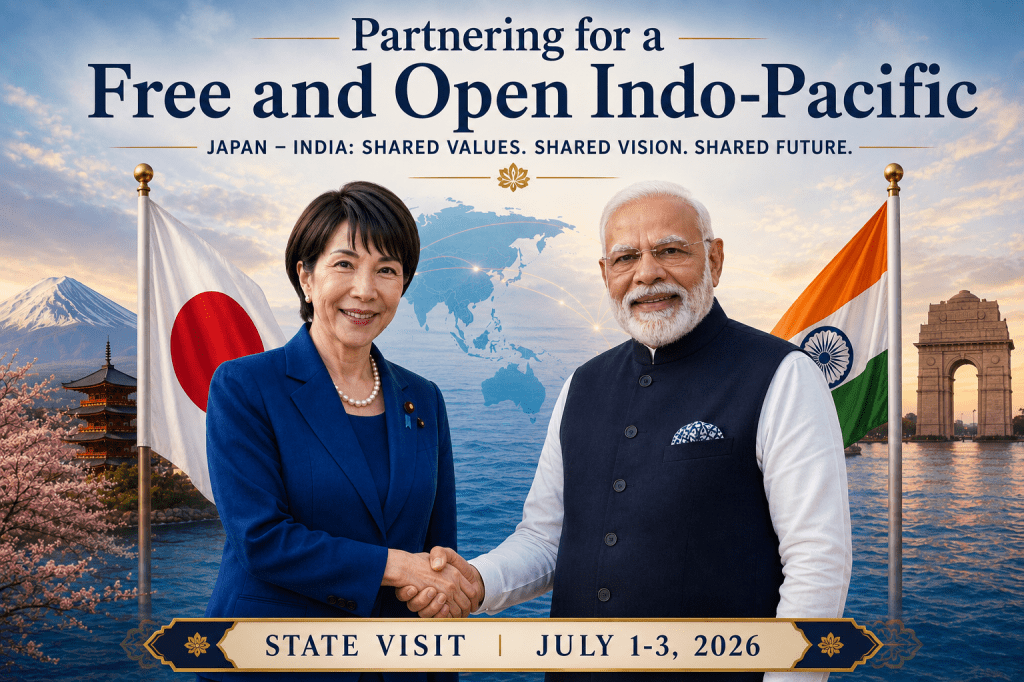
Japanese Prime Minister, Sanae Takaichi was on a state visit to India from July 1-3 to attend the 16th India–Japan Annual Summit in New Delhi. The meeting was extremely significant for the bilateral ties as well as for the vision of “free and open Indo-Pacific” a message that Prime Minister Takaichi has strongly voiced in all her state visits abroad after becoming Japan’s first woman Prime Minister in October 2025.
Her India visit was particularly consequential for a new era of Indo-Japanese cooperation for economic security, defense cooperation, resilient supply chains, AI, semiconductors, and the larger unfolding geopolitics of the Indo-Pacific.
The Indo-Pacific politics talked with Dr. (Prof.) Satoru Nagao, a Fellow (Non-Resident) at the Washington DC based Hudson Institute (Tokyo-based) and an Associate Professor at the Institute for International Strategy, Tokyo International University about the importance of Prime Minister Takaichi’s visit to India.
Particularly noteworthy in this interview are Dr. Nagao’s views on the fundamentals of PM Takaichi’s vision for Indo-Japanese cooperation, particularly in fostering a “free and open” rules based order in the Indo-Pacific.
The Indo-Pacific Politics: What according to you was most striking about PM Sanae Takaichi’s visit to India and why do you think so?
Dr. Satoru Nagao: She reconfirmed how important the relationship is. Recently, the US downgraded the value of its relationship with India. For example, the name of the US military command changed from the Indo-Pacific Command to the Pacific Command. War Secretary, Heathes did not use the word “Indo-Pacific” in his speech at the Shangri-La Dialogue. And recently, the US changed the word “Quadrilateral Security Dialogue” to “Quadrilateral Dialogue.” Along with other leaders of the G7, President Trump also met PM Modi [on June 17 in France]. And he said he will fight for India if the leader is Modi.
He said, “If anybody attacks that man(PM Modi), we’re going to be there… Now, if there’s a new leader, I’m not sure about it.
“The part, “Now if there’s a new leader, I’m not sure about it” is very important message.
The Indo-Pacific Politics: How will Indo-Japan’s joint focus on “free and rules-based Indo-Pacific” help the cause of the greater region?
Dr. Satoru Nagao: Without India, there is no need for the Indo-Pacific. Without India, “QUAD” is meaningless, because the US, Japan, and Australia are US allies and have an easy chance to cooperate without a new concept like QUAD.
This means that downgrading the Indo-Pacific and the QUAD means downgrading India. But why [should that even be the case]?
The Indo-Pacific Politics: India and Japan also signed their first agreement for co-development of defense projects. What’s most significant about it? How do you think this will develop in the next five years?
Dr. Satoru Nagao: The message of President Trump is clear, indeed. US allies and partners must prove their contribution to American interests. Without enough contribution to the American Interests, Americans will not help.
Recently, the Trump administration has pressured its US allies in Europe because President Trump sees European allies as not contributing enough to American interests. Now, Americans have started to think that India does not contribute to American interests well.
That is why the downgrade of the Indo-Pacific and the QUAD is happening. Therefore, now, the concept of “Indo-Pacific” and “QUAD” is under threat.
The Indo-Pacific Politics: Prime Minister Modi and Prime Minister Takaichi signed at least 129 MoUs on technology, investment and Artificial Intelligence (AI). What kind of impact will this have on India’s economy and the larger supply chains in the Indo-Pacific region?
Dr. Satoru Nagao: Originally, Japan was a pioneer of this concept. [Former] PM Abe’s speech in the Indian parliament in 2007, “Confluence of Two Seas” was the first public address of the Indo-Pacific. And the address also includes [his thoughts about] cooperation with the US and Australia.
Shinzo Abe also published [an essay] “Asia’s Democratic Diamond” in 2012 [before the beginning of his second term as the Prime Minister of Japan], explaining his real motivation, which is to counter China. Therefore, if the Indo-Pacific and QUAD are under threat, Japan should take charge to explain [to the world] why the Indo-Pacific and QUAD is important.
The Indo-Pacific Politics: Abe’s essay, “Asia’s Democratic Diamond” published by Project Syndicate became one of the intellectual foundations for what later evolved into Japan’s Free and Open Indo-Pacific (FOIP) strategy and the revival of the Quad (Japan, India, the United States, and Australia) which originally started in.
Abe wrote: “Peace, stability, and freedom of navigation in the Pacific Ocean are inseparable from peace, stability, and freedom of navigation in the Indian Ocean. Japan, as one of the oldest sea-faring democracies in Asia, should play a greater role – alongside Australia, India, and the US – in preserving the common good in both regions.”
The essay can be read here: Asia’s Democratic Security Diamond
The Indo-Pacific Politics: Is there anything else that you would like to share on this topic with my readers?
Dr. Satoru Nagao: PM Abe’s address in 2007, clearly mentioned that “a strong India is in the best interest of Japan, and a strong Japan is in the best interest of India.” That is the key part of the Indo-Pacific and QUAD.
This time, PM Takaichi published an article [in India’s largest circulating newspaper, Times of India on July 1 ], “Japan and India: Strategically Aligned Trusted Partnership” and quoted the sentence, “A strong India is good for Japan and a strong Japan is good for India.”
Her quoting this sentence gives a message that Japan is re-emphasizing how important India is and [Japan is] remembering India through the memory of PM Abe. This is Japan’s will to persuade both PM Modi and President Trump. That is strategically very important about this visit.
The Indo-Pacific Politics: Here’s an except from PM Takaichi’s article that Dr. (Prof.) Nagao is referring to in this interview: “As former Prime Minister Shinzo Abe once stated, ‘A strong India is good for Japan and a strong Japan is good for India.’ I am firmly convinced that, by leveraging each other’s strengths and becoming ‘more resilient and prosperous together’, we will serve the interests of both nations.
“It is here in India that the very concept of today’s ‘Free and Open Indo-Pacific (FOIP)” first took root. ‘The different streams, having their sources in different places, all mingle their water in the sea.’ Prime Minister Abe, in his speech to the Indian Parliament, quoted these words of Swami Vivekananda in declaring that we should view the Pacific and Indian Oceans as one and that it is our shared responsibility to pursue freedom and prosperity by cooperating with like-minded countries. This vision remains as relevant as ever, and there is a compelling need for Japan and India to cooperate in realising this goal.”
The Indo-Pacific Politics: How will Indo-Japan’s joint focus on “free and rules-based Indo-Pacific” help the cause of the greater region?
Dr. Satoru Nagao: When we check the three features of China’s territorial expansion, we can understand why [it’s important]. China’s territorial expansion has many similarities in sea around Japan, Taiwan, in the South China Sea, the South Pacific, the Sino-Indian border area, and the Indian Ocean region.
China’s territorial expansion has three features. The first feature to be noted is China’s repeated disregard for current international law when laying claim to new territory. In the East China Sea, China did not claim the Senkaku Islands before 1971, but its attitude has since changed. The Senkaku Islands are in a strategic location to pressure Taiwan and have potential oil reserves.
In the South China Sea, China has expanded its territorial claim, ignored the verdict of an international court, and built artificial islands. And China has started to deploy missiles and military planes on the islands, despite insisting they have no military purpose. Indeed, this was the same pattern China followed when it set up a military base in Djibouti [in the Horn of Africa].
China continues to make incursions along the Sino-Indian border, although the Tibetan exile government has stated that these areas belong to India. China has ignored current international law and expanded its territorial claim in all three areas.
The second feature of China’s territorial expansion is timing. Beijing has exploited the situation whenever it finds a power vacuum. For example, China occupied half of the Paracel Islands just after France withdrew in the 1950s. By 1974—one year after the US withdrew from South Vietnam—China occupied the other half of the islands. In the 1980s, China expanded its activities in the Spratly Islands and occupied six features there in 1988, just after the Soviet Union decreased its military presence in Vietnam. And in 1995, China occupied Mischief Reef three years after US troops withdrew from the Philippines. These activities indicate that China tends to expand its territorial reach when military balances change and power vacuums are detected.
If that observation is true, China will continue to escalate its activities. Over the past decade, the military balance has been changing. According to the Stockholm International Peace Research Institute (SIPRI) Military Expenditure Database, from 2011-2020 China increased its military expenditure by 76 percent. During the same period, India increased its military expenditure by 34 percent, Australia by 33 percent, and Japan by only 2.4 percent. The United States decreased its expenditure by 10 percent. China has tried to expand its territorial claims in the South China Sea, the East China Sea, Taiwan, the South Pacific, the Sino-Indian border, and the Indian Ocean because it sees a power vacuum in these areas.
A third feature of China’s territorial expansion is non-military control. China has used foreign infrastructure projects—known as the Belt and Road Initiative (BRI)—to expand its sphere of influence. Countries with significant Chinese investment and debt are hesitant to criticize China, even when it flouts international rules. China has also been using “vaccine diplomacy” for COVID-19 to foster goodwill among recipient countries. Thus, for China, non-military methods like infrastructure projects, supply chain dependence, and vaccines serve to expand its influence and power. Even on developed countries like Japan and Australia, China uses this method of economic control. For example, when Australia insisted on an international investigation to identify the origin of COVID-19, China delayed processing Australian imports like wine and lobster. Dependence on the Chinese market is a powerful weapon for Beijing to expand its influence, and ultimately expand its territories.
How does the QUAD work? A lack of respect for international law, expansion of territorial claims where there are power vacuums, and attempts at economic dominance or other non-military methods to expand influence abroad are all common themes of China’s exploits in the whole Indo-Pacific. Thus, the question remains: How should the QUAD countries, including Japan, respond? Knowing the pattern of China’s behavior points toward the answer: They should do the opposite of what China wants.
First, the QUAD must continue to respect and insist upon a rules-based order grounded in current international law. The joint statements of both QUAD summits in March and September 2021 mention that a free, open, rules-based order will “meet the challenges to the rules-based maritime order, including in the East and South China Seas.” These words carry great significance because China has tried to change the status quo by force and continually challenges international norms. Other bilateral and multilateral summits also made similar statements.
For example, during the US-Japan 2+2 foreign and defense minister-level meeting in March 2021, the joint statement mentioned China by name multiple times and expressed concern over China’s activities in the East China Sea and South China Sea, Taiwan Strait, Hong Kong, and Xinjiang. Such a clear stance shows Japan’s support for the current rules-based order and democratic norms. Following the G7 meeting with India’s and Australia’s foreign ministers in May 2021, the joint statement also mentioned Tibet. And the new US-UK Atlantic Charter has sent a particularly strong message. Originally created during World War II, the Atlantic Charter formalized the Allied vision for a postwar world. Now, the US and UK have renewed the Atlantic Charter to send another message about what kind of world democratic countries should seek to establish.
Second, QUAD countries need to fill perceived power vacuums by maintaining a military balance. To do this, they need to increase their defense budgets—not an easy task. Therefore, reorganizing the security system itself is important. As mentioned above, between 2011-2020 China increased its military expenditure by 76 percent, and the US decreased its expenditure by 10 percent. Even if the US military expenditure were three times bigger than China’s, the current “hub and spoke” system would still not be enough.
What can the QUAD do to discourage China’s territorial expansion? If QUAD countries coordinate well, they can force China to defend multiple fronts at once. In such a scenario, China would need to simultaneously make defense expenditures against the US and Japan on the Pacific side as well as against India on the India-China border side. This sort of cooperation would provide a way to maintain a military balance even if China’s military expenditure were rising at a rapid pace.
Offensive capability is key. For a long time, no countries except the US possessed enough capability to attack China. However, if the US, Japan, and India all possess long-range strike capabilities, their combined capability forces China to defend multiple fronts. Even if China decides to expand its territories in the Sino-Indian border, it will still need to expend a certain amount of its budget and military force to defend itself against a potential attack from the US and Japan. Currently, Japan, India, and Australia are all planning to acquire 1000-2000 km long-range strike capabilities such as cruise missiles and F-35 jets with glide bombs. And indeed, Taiwan, Vietnam, the Philippines, and South Korea are also increasing their strike arsenal with surface-to-surface missiles. These moves could be critical.
In September 2021, Australia, the UK, and the US announced that they had formed AUKUS, a trilateral security arrangement in the Indo-Pacific. In this alliance, the US and the UK will support Australia to acquire and maintain eight nuclear submarines. If Australia acquires nuclear submarines with long-range strike capabilities, Australian naval forces can operate in a far wider area in the Indo-Pacific (including sea around Taiwan) and potentially counter China’s threat in that area.
Third, the QUAD needs to integrate non-military efforts into its overall strategy. These will be a very important part of any counter-China strategy, because China’s threat is bound up with the strength of its budget. China can change the status quo by force when its military power is stronger than others, and so maintaining a military balance is important. However, because of its strong economy and ample budget, China’s military modernization has outpaced other countries. That is why non-military efforts are needed to reduce China’s economic advantage.
In the case of foreign infrastructure projects, the situation is the same. Because of its favorable economic situation, China can invest heavily in these projects and create huge debts and obligations for recipient countries. These countries then tend to follow China’s lead in international organizations such as the World Trade Organization. Therefore, reducing China’s ample budget and its influence is an important priority.
Therefore, the “Free and Open Indo-Pacific” is important. It emphasizes rule-based order, divides China’s budget into a multiple fronts, and also promotes infrastructure projects.
China is a top-three level trading partner for the US, Japan, Australia, and India. But if these countries depend too heavily on trade with China, their economies will be hostage to it. QUAD countries cannot take a strong stance against China and rely heavily on trade with it at the same time. Therefore, QUAD countries need to integrate their economic efforts and reduce their reliance on China. Decoupling and risk-diversifying of supply chains and markets are necessary.
The Indo-Pacific Politics: India and Japan also signed their first agreement for co-development of defense projects. What’s most significant about it? How do you think this will develop in the next five years?
Dr. Satoru Nagao: Indeed, the first co-development project has already been done. Unmanned Ground Vehicle project between the Ministry of Defense of the two countries. But this time, they agree on the naval antenna UNICORN project. In military activities, the Navy needs to communicate secretly. Thus, such military communication equipment will promote joint activities of India and US allies, including Japan.
Indeed, it will promote naval ship trade, too. This time, they have not talked about the joint development project based on Japan’s Mogami-class frigate. But UNICORN is a part of it.
And such naval cooperation promotes another level of naval cooperation because the same equipment promotes maintenance cooperation that could promote deployment with each other. In the joint statement, “They concurred on deepening maritime security cooperation through enhanced exercises, maritime domain awareness using satellite capabilities, naval maintenance, repair and overhaul (MRO) cooperation, and defence equipment and technology cooperation under the framework of “Make in India”.
In this naval maintenance, repair, and overhaul, cooperation is vital for the two navies to cooperate. Japan’s naval ship deployed on the coast of Somalia can visit India for maintenance and vice versa. Such cooperation enhances the deployment of naval ships with each other.
The Indo-Pacific Politics: Modi and Takaichi (two countries) signed at least 129 MoUs on technology, investment and Artificial Intelligence (AI). What kind of impact will this have on India’s economy and the larger supply chains in the Indo-Pacific region?
Dr. Satoru Nagao: For India and Japan, trade shared only 1 or 2 % of total trade each other. Thus, trade itself has not developed well. Indeed, Japan’s investment to India looks like “Widow Shopping.” They visit the ship and check the products they want to buy, but they are only watching and have not bought yet. Japanese companies set up a satellite office in India. But they have not started a big business yet. Simply, they hesitated to do this.
But from the Japanese government’s view, they want to push these Japanese companies to start business. Japanese government does not want to rely on the Chinese market; the rise of the Indian market is in Japan’s interests. That is why PM Takaichi led the move and signed more than 129 MoUs.
AI is also important to promote business because AI promotes the speed of business. But at the same time, AI is dual-use. Indeed, Japan is planning to start a joint development project of a drone system with AI as a weapon. If drones have AI, jamming will not stop drones. Thus, it will be a game-changing weapon. And in the world, many people who develop AI are Indian. Japan is focusing on this research with Indians.
The Indo-Pacific Politics: Is there anything else that you would like to share on this topic with my readers?
Dr. Satoru Nagao: PM Takaichi is a real expert in economic security. She was the minister responsible for economic security and published many books on the subject in Japanese. The supply chain of anything, including rare earth, must not rely on China.
And she is also focusing on energy security, which could involve sharing storage with each other. In the near future, neither India nor Japan will worry about the blockade of Hormuz.

QUAD Interviews is a series of conversations between journalist, Venus Upadhayaya and experts in the Indo-Pacific domain on topics of relevance to the geopolitics of the region. Pitch to venusupad@gmail.com
VENUS’ OTHER RELATED WORK:
- QUAD must ’emerge as a credible alternative economic and strategic model’ for the Indo-Pacific region: Analyst
- ‘Rethinking the Hub and Spoke’ Approach to East Asian security Can be Central to Taiwan’s Defense: Expert
- Between Expansion, Pushback, Bipolar and Multipolar Worlds Taiwan Strait is Today’s World’s Dystopia